This story is currently available in Englisch only — a translation isn't ready yet.
"Theodore Roosevelt" joins two American carriers... Washington expands its military options against Iran
The arrival of the third carrier in the Middle East coincides with the blockade of Iranian ports and Tehran's announcement that it targeted an American base with drones
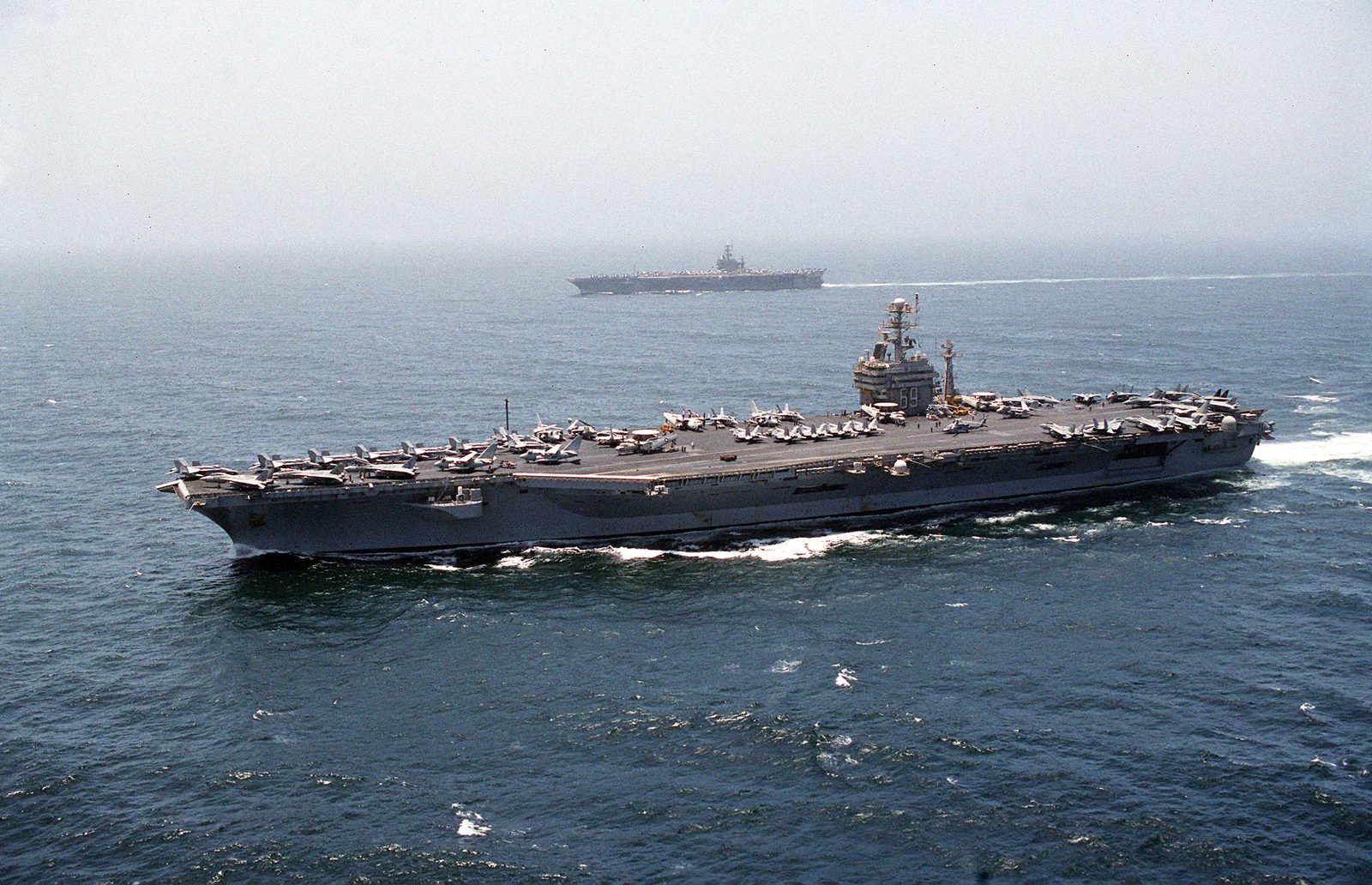
The US aircraft carrier "Theodore Roosevelt" has arrived in the Middle East, joining "George Washington" and "George Bush", raising the number of American strike groups in the region to three, in a step that coincides with the faltering of diplomatic efforts to contain the escalation between Washington and Tehran.
The naval buildup comes after weeks in which the conflict was focused primarily on the sea, where the United States is imposing a blockade on Iranian ports, while Tehran is trying to expand its influence in the Strait of Hormuz. Explosions were heard in Bahrain, while Tehran announced it had targeted an American base with drones.
On the political track, US President Donald Trump engaged with an article by Republican Senator Tim Sheehy in the "Wall Street Journal" in which he called on the American administration to continue the confrontation with Iran and not to retreat, and Trump described the article as "very important and worth reading", then reposted it through his account on the "Truth Social" platform.
Sheehy argues that the unpopularity of war with American public opinion does not necessarily mean that the decision to wage it is wrong, citing the experience of former US President Harry Truman during the Korean War in 1950, then the experiences of Lyndon Johnson in Vietnam and George W. Bush in Iraq. He says that the Iranian leadership has bet for 47 years that threats push American administrations to retreat, and in this context he enumerates the targeting of one of the senior leaders of the Iranian "Revolutionary Guard" in 2020, then the strikes that targeted the Iranian nuclear program in 2024 and the current military confrontation in 2026.
On the other side, Pakistani Foreign Minister Ishaq Dar continued on Monday his country's moves to reduce the intensity of tension between Washington and Tehran with the support of regional countries, during the "Economic Cooperation Organization" meeting in Islamabad, with the participation of foreign ministers and diplomatic officials from the ten member states. The minister said that peace and stability represent a fundamental condition for achieving economic development. Islamabad hosted the first round of direct talks between Washington and Tehran last April.
Iranian Foreign Minister Abbas Araghchi said at the same meeting that his country has always adhered to the principle of peaceful settlement of disputes, including through diplomatic means, but "the United States is the one that chose a path far from negotiation".
The arrival of the third carrier was not accompanied by an announcement of a date for any military action, nor by an announcement of the resumption of negotiations; what was announced is the strengthening of naval capabilities, while the decision and the timetable were not mentioned in any of the declared positions.
Sources — how we know this
2 independent sources corroborated this
- PrimaryAsharq Al-Awsat
- CorroboratingThe National (UAE)