This story is currently available in Englisch only — a translation isn't ready yet.
Morning Briefing: Nasdaq Lost $1.2 Trillion in October, Gold at $3,899, Peg at 3.7500
As Wall Street debates the artificial intelligence bill, troy ounce gold trails its peak by 28%; Gulf pegs remained unmoved again, TASI entered the week at 9,922.
The week requires examination from three separate fronts: technology selling in New York, gold retreat in London, silence in Riyadh. All three are different readings of the same story.
First, there is an account that needs settling. On October 14, from this column I gave a two-week pledge tied to the Fed framework and Gulf banks' 2027 credit growth revisions. The term expired today, and neither condition appears in today's source package. This is a NO EVIDENCE record; not a miss but not a hit either, and it passes to the reader that way.
Now, overnight movements. According to data relayed from local press, Nasdaq fell 4% on Friday, reaching the edge of the technical correction zone; October losses exceeded $1.2 trillion. Following below-expectation guidance, Intel experienced its sharpest single-day decline in over 40 years; an international outlet reported intraday movement reaching as low as 30%. On the Amazon side, a local economic publication noted shares fell 2%, while an international outlet highlighted intraday selling reaching 6% — the swelling of the capital expenditure line item is common in both narratives. The S&P 500 lost over 2%. Alphabet's market value loss exceeding $500 billion on Thursday — following the admission that artificial intelligence summaries are eroding search ad revenue — completes the picture. The issue is no longer the artificial intelligence story; it is the artificial intelligence bill: who pays, when does it turn around.
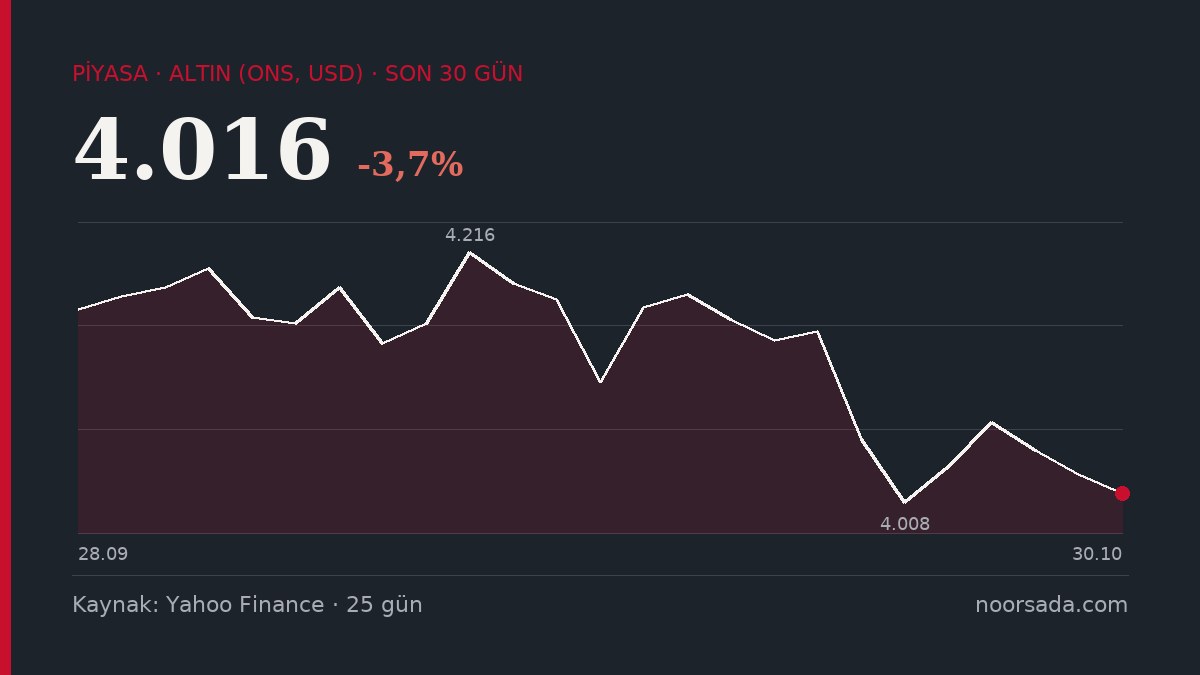
The gold side is the flip side of the same concern. Troy ounce gold, which rose to $5,595 in January, has retreated to $3,899 today, losing over 28% from its peak; the $4,000 barrier is now being discussed as support rather than resistance. A local economic publication, citing an international commodity institution's pricing model, notes the $4,900-$5,000 band for Q1 2027 — roughly 25% upside potential from current levels. This is a forecast, not data; we are simply putting the level on record.
On the energy front, an agency report out of Bishkek relays the Oxford Institute for Energy Studies' latest monthly report: if transit pressure over Hormuz and Bab el-Mandeb persists, Brent could rise to $131 per barrel in Q4 2026 and $96 in 2027 — $19 and $9 above the base scenario. The same institution is also keeping on the table a path where, in the reverse scenario, full production recovery pulls the 2027 average down to $83 per barrel. What matters for the Gulf is this: the energy premium still exists, but its direction depends on which of the two forecasts holds.
Pegs remained silent this morning too: USD/SAR 3.7500, USD/AED 3.6725. TASI closed the week at 9,922 on October 29; that level is the reference ahead of today's opening. What matters is this asymmetry: Wall Street's artificial intelligence bill is paid by technology shareholders, the cost of the gold correction is borne by those who bought at the peak, but in both ends of the Brent scenario, the Gulf budget sits. The expense of optimism and pessimism alike is charged to the same address.