This story is currently available in Englisch only — a translation isn't ready yet.
Urals Sits $31 Below Brent as the Fed Prices In December — the Peg Imports Two Fires at Once
October PPI came in below expectations but September was revised higher; Collins and Goolsbee defended tightening. Urals is at its widest discount since April 2023. TASI at 10,326, the peg again at 3.7500.
At Friday's close the Gulf's two iron anchors again did not budge: USD/SAR 3.7500, USD/AED 3.6725. TASI said goodbye to the week at 10,326. But behind these fixed levels, two price moves took place simultaneously today between Washington and Moscow; both reach all the way to Riyadh's table and to Dubai's rent.
First there is an account to settle. On 9 November, in this column, I wrote that the US-Russia-Ukraine trio in Abu Dhabi would not produce a one-way move exceeding 2% in Brent's daily close in the first 48 hours after the meeting. Today the referee closed the promise as 'could not be assessed' — we do not have official ICE Brent closing data for 11-12 November. This is not a hit, it is missing data. An honest word to the reader: my thesis has been neither proven nor rejected; the same promise, which I left open until 14 November for the next two weeks, is still on the board.
Now to today's two moves. According to US Labor Department data carried by the local press in Washington, October PPI rose 0.3% month-on-month; the market expected 0.4%. The annual figure came in at 6.5% against an expectation of 6.6% — but the September figure was revised up from 1.3% to 1.4% month-on-month. Core PPI stuck to expectations on both the monthly and annual basis: 0.3% and 5.0%. The sentence the price is saying: the headline softened, the inner bone did not.
On the Fed side, the tone did not soften at all today. Collins, in the text prepared for the Boston Fed's annual conference, acknowledged that high rates are narrowing housing affordability, but said that over the long run price stability creates a 'predictable condition' for the sector — translation: we will keep squeezing housing. Goolsbee, on CNBC, said 'there are definitely things the central bank needs to do to continue to regain its credibility on inflation' and described the October consumer inflation data as 'on the troubling edge.' Both are members of a board that tightened in September for the first time in three years. Futures markets are currently pricing a rate hike in both December and January; March or April is marked for a third hike.
This is monetary policy imported one-for-one into the Gulf. As long as the peg stays fixed at 3.7500, SAMA has no luxury of doing anything independent of the Fed — if Washington tightens, Riyadh tightens, and Dubai tightens. For a Turkish reader the translation is even more painful: the Fed's signal of another hike in December is a candidate to push up the rent of the studio in Dubai and the dollar-based financing cost of the Vision 2030 project in Riyadh. The CBRT's raising of its 2026 year-end inflation forecast to 29.5% coincided with the same week as the Fed's signal that it will continue tightening; these two curves look in the same direction, but at different speeds.
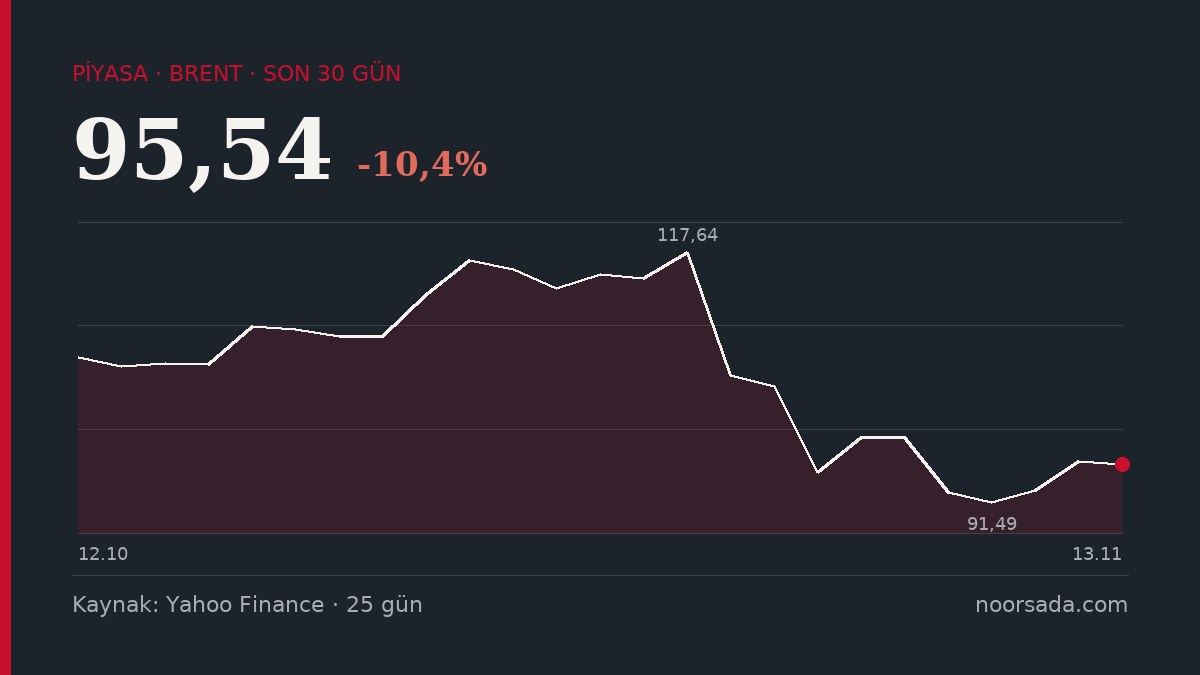
On the oil side today's signal is even sharper. According to Argus data carried by the local Russian press, Urals was offered between 1-6 November at a $31 discount to Brent in the Baltic and a $33 discount in Novorossiysk — the widest spread since April 2023. India's imports through the Strait of Hormuz rose to 2.1 million barrels per day in November, surpassing the 1.8 million barrels it buys from Russia. BCS World of Investments analyst Kirill Bakhtin said rising supply from Gulf producers is heating up competition with Urals. Sergei Frolov of NEFT Research noted that high freight costs make Russian crude less competitive. Vector Capital analysts assessed that Russian producers' revenues have peaked. Russian crude for December delivery to India's west coast fell $2.30 to $94.38 a barrel — a $2.25 discount to Brent, the first time since August.
Note the irony here: Moscow, as I wrote on 9 November, is paying in export revenue the cost of hiding its body count. The Gulf, meanwhile, is at one and the same time talking Houthi attacks with China — Saudi Foreign Minister Prince Faisal bin Farhan met China's Special Envoy for the Middle East Zhai Jun in Riyadh — and quietly selling Gulf crude into India. Diplomacy at the table, market share in the pipeline.
To watch for Monday: after the US October PPI, the December hike pricing opened up by Collins and Goolsbee will test TASI's banking index and the spreads on Saudi-issued dollar sukuk. The peg will stay silent — as always. Today's answer to the question of who pays the bill for optimism: the Russian exporter carrying Urals. The collection goes to the Gulf producer and to Riyadh's borrowing desk.