This story is currently available in anglais only — a translation isn't ready yet.
Suez Canal: $180 Billion in Revenues Over 157 Years, 1.5 Million Ships Transited
Authority chairman announced the navigation figures on the opening anniversary: 35.8 billion tons of net tonnage... and last month's revenues jumped 94% to $724 million
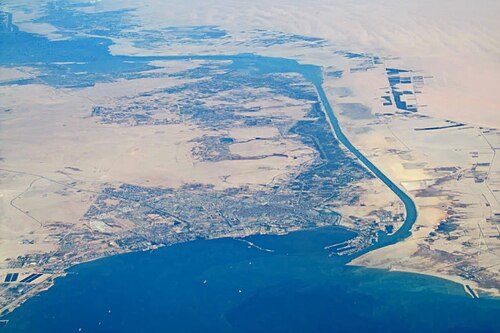
Suez Canal Authority Chairman Lieutenant General Osama Rabie announced that navigation statistics have recorded, since the canal's opening, the transit of nearly 1.5 million ships, with total net tonnage reaching 35.8 billion tons and cargo volumes estimated at about 28.9 billion tons between East and West.
The announcement came on the day the Authority marked the anniversary of the canal's opening, Tuesday, 17 November 1869. Rabie said in a Tuesday briefing that "these figures reflect the strategic importance of the canal over 157 years," and that they are part of the global trade movement system. The Authority estimated the financial returns achieved over a century and a half at about $180 billion.
The canal's revenues recorded a jump last month of up to 94 percent year-on-year, at $724 million, bringing total revenues for the current year to $6.6 billion, according to Authority data. The canal is one of the most important sources of foreign currency for the Egyptian economy, as it contributes to providing hard currency and supporting the monetary reserve and the state treasury.
Egyptian President Abdel Fattah El-Sisi said, during the "Egypt Forum 2026" held last month, that his country "incurred cumulative losses amounting to about $20 billion in Suez Canal revenues as a result of regional turmoil," noting that navigation traffic and the passage of ships "are witnessing a gradual improvement."
Ahmed Amin, adviser to the former Minister of Transport for Maritime Transport, pauses at the implications of the timing of the announcement, considering that it "presents a message that the canal still retains its centrality in global trade movement," despite the geopolitical changes and wars the region is witnessing. He added that "there is a decline in the number of ships passing through the canal" due to tensions in maritime corridors such as the Bab al-Mandab Strait and the Strait of Hormuz.
For his part, Egyptian economic expert Medhat Nafeh believed that "there is no navigational alternative to the Suez Canal," and that the proposed alternatives "provide for trade movement seasonally, not sustainably." He considered that documenting navigation figures throughout 157 years reflects "institutional discipline" in the management of the canal.
The Houthi attacks in the Bab al-Mandab Strait, after the Gaza war, had caused global shipping companies to redirect ship transit voyages to the Cape of Good Hope route, as an alternative to the Suez Canal.
Sources — how we know this
2 independent sources corroborated this
- PrimaryAsharq Al-Awsat
- CorroboratingYoum7