This story is currently available in anglais only — a translation isn't ready yet.
Two Arrests in Astana, One Discount, and Two Reactors by 2035
The heads of Samruk-Kazyna and KTZ were detained on 11 November; the same week Urals in the Baltic stood $31 below Brent. TASI 10,326, riyal 3.7500, dirham 3.6725.
ℹ️ Lecture par le navigateur · voix studio IA bientôt

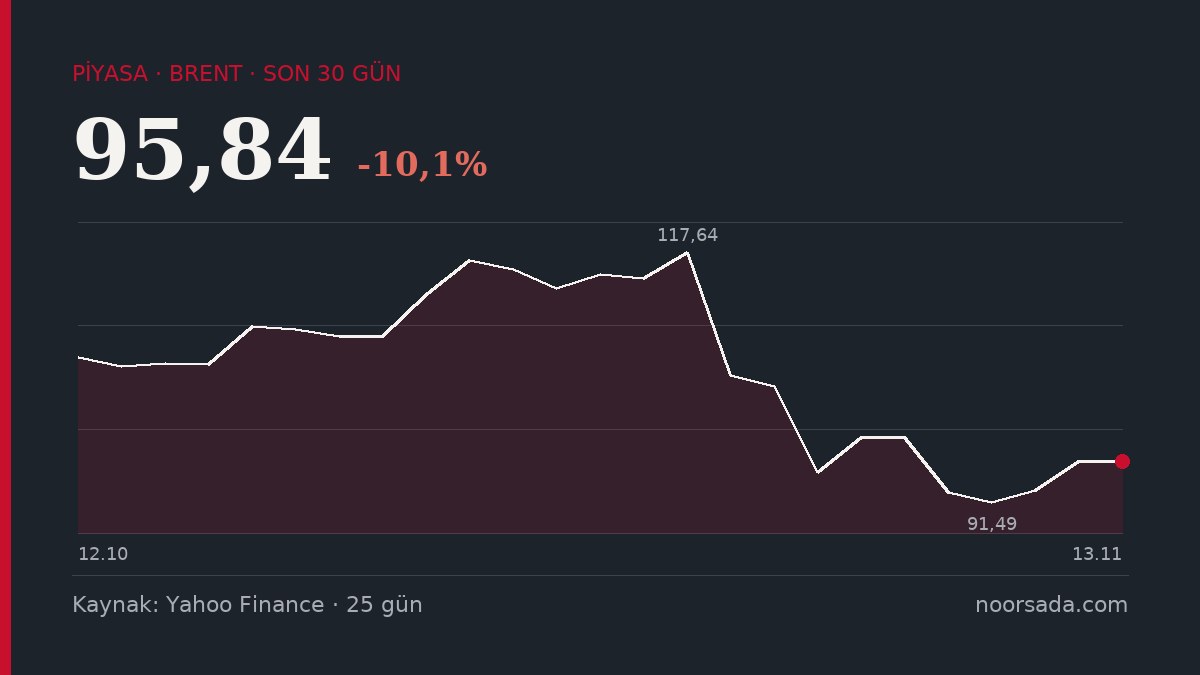
First, settling the debt. Two promises I made at the end of October have today been stamped 'could not be assessed' on the referee's table: the 11-12 November Brent closes and the weekly foreign flow series for Nasdaq and Tadawul are not in the archive. I can say neither that they held nor that they did not. I will not polish this as a hit; if the record does not stay honest, neither does the read.
The numbers we have left are plain: TASI at 10,326 as of 12 November, USD/SAR 3.7500, USD/AED 3.6725. There is not a single flicker on the peg side. This week's story is not in the currency; it is in the barrel and in two sets of handcuffs.
In Friday's piece I had written about Urals' $31 discount to Brent. Now let us look at the mechanics of that number, because the mechanism is not where it is thought to be. According to Argus price data, in the 1-6 November window Urals was offered at $31 below Brent at Baltic ports and $33 below at Novorossiysk; both are the widest discount since April 2023. But this is not a supply-cut story. Exports from the Baltic are at early-October levels at about 1.5 million barrels per day, and Novorossiysk at 762,000 barrels has barely changed. So Russia is paying in price, not in barrels.
On the other side of the price paid there is a redistribution. According to data from ship-tracking firm Kpler, India's imports via Hormuz rose to 2.1 million barrels per day in November while its imports from Russia stayed at 1.8 million barrels. Kirill Bakhtin of BCS World of Investments says supply from Gulf producers has increased competition for Urals; Sergei Frolov of NEFT Research adds that high freight rates have pushed Russian barrels back in the competition. Vector Capital analysts note that producer revenues have peaked and that Gulf shipments are approaching pre-war levels. Russian crude for December delivery was priced at $94.38 on India's west coast, that is $2.25 below Brent: the first time since August.
The other half of the same week is in Astana. On 11 November, Samruk-Kazyna chief executive Nurlan Zhakupov and Kazakhstan Temir Zholy chairman Yelzhas Otynshiyev were detained by the anti-corruption service of the National Security Committee; the KNB confirmed on 12 November that both were in custody and gave no details. Speaking at the Security Council on 13 November, President Kassym-Jomart Tokayev put the sentence himself: 'This is an extremely serious sign of widespread corruption in state companies.' He added that the investigation had only just begun and that it was too early for details.
Right on that table sits a ten-year bill. Astana plans to complete the Balkhash and Moyunkum plants by 2035. Balkhash, with a Rosatom-led consortium, is a project of about $16.4 billion with two VVER-1200 units and 2,400 MW of capacity; for Moyunkum talks are under way with China's CNNC, with cost and schedule still under negotiation. An intergovernmental agreement was signed in May 2026, and in September the design, procurement and construction contract was tied up.
For the peg reader this is a Fed story: a dollar-denominated commitment spread over ten years sits on the same interest-rate curve that a housing loan in Riyadh carries. The two arrests, meanwhile, have made the signing side of that commitment questionable.
The asymmetry is here: in the discount we know who pays, Moscow, per barrel. The one who collects is also clear: the refiner buying cheaper barrels and the shipowner billing the high freight. In the arrests, the payer is Astana's balance sheet and the foreign partner; the collector is the buyer seeking cheaper barrels. The two stories are two halves of the same week: one cleans the price, the other soils the trust.
My call: by Friday, 20 November, in the weekly ship-tracking data, India's imports via Hormuz will remain at least 200,000 barrels per day above its imports from Russia.