This story is currently available in anglais only — a translation isn't ready yet.
Brent at $125.44 Meets a US Wellhead That Will Not Flinch
American crude output printed 13.979 million bbl/d last week while Cushing sat at 24.7 million barrels. The price is doing the work the physical system refuses to do.

US crude production reached 13,979 thousand bbl/d in the week to 2 October. That is the physical number that matters this morning, and it is the number the price tape is currently failing to respect.
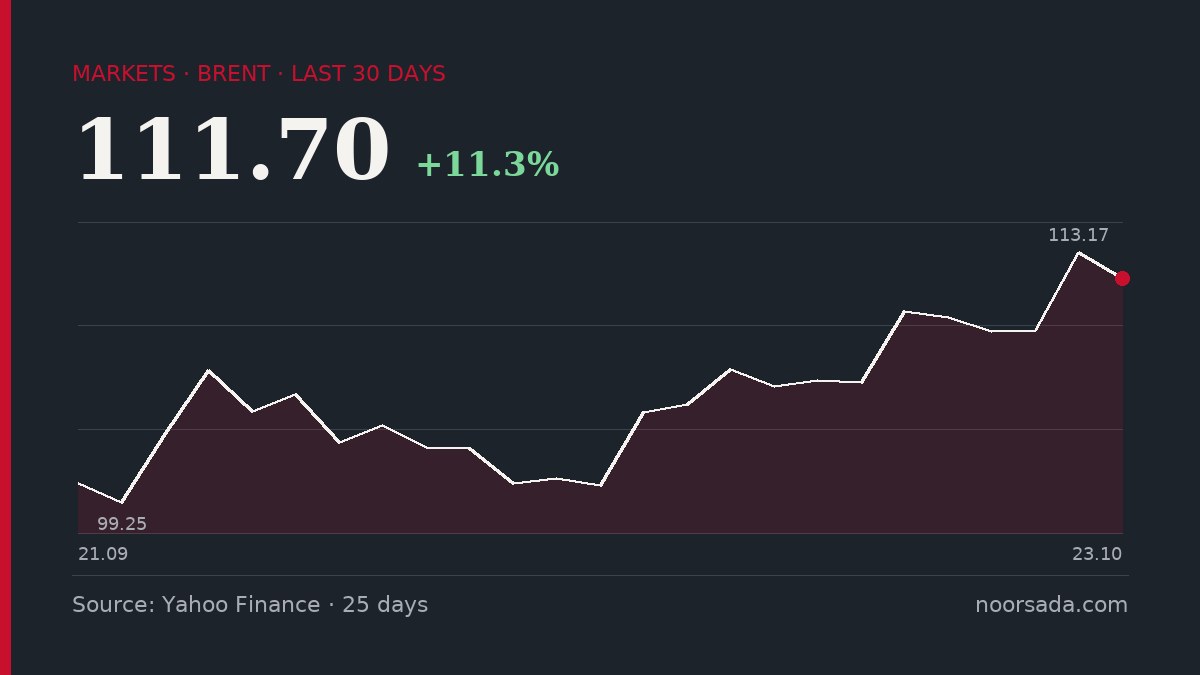
Brent printed $125.44 on 6 October, per the daily EIA assessment. The gap between that quote and the wellhead reality in the Lower 48 is where the next quarter will be fought. A price above $120 historically pulls incremental American barrels within two to three quarters of sustained signal. The 13.979 million figure already sits near the upper band of what US acreage has delivered in any prior cycle; the question is not whether more comes, but how much more and how fast.
The cause behind the price is geopolitical, and I will keep it to one paragraph. Houthi strikes on Saudi territory — condemned this week by France and a bloc of Arab and Islamic states — are reintroducing a risk premium into Gulf-loading cargoes that the market had partly priced out through 2025. That premium is financial. It is paid by refiners and recovered, if at all, at the pump. It does not, by itself, remove a single barrel from the loading schedule at Ras Tanura.
Now the ledger. On supply: American output at 13.979 million bbl/d is a hard ceiling-tester, and OPEC+ discipline remains the swing variable I cannot quantify from today's data. On inventory: Cushing held 24,745 thousand barrels as of 2 October. That is a thin cushion by the standards of the last decade — the hub was built to carry considerably more, and tank-bottom logistics begin to bite well before zero. A thin Cushing is why WTI structure can move independently of Brent on any given day, and why a refinery turnaround in PADD 2 shows up in the screen faster than it used to. On demand: refinery margins at current crude prices compress unless product cracks hold, and product cracks hold only while driving and distillate pulls stay firm into the northern winter.
Trace the route. A barrel loaded at a Saudi terminal today, insured at a war-risk premium that has widened since the latest Houthi salvo, sails east more often than west — Asian refiners remain the marginal buyer and the marginal price-setter for Arab Light differentials. A barrel produced in the Permian moves by pipe to the Gulf Coast, where it either clears into export via Corpus Christi and Houston or backs up into Cushing. When Cushing sits at 24.745 million barrels, the second option is constrained. That constraint is why US producers have, for now, a bid under their realised price that the headline Brent number understates.
Separate the physical from the financial, because the desks that confuse the two are the desks that lose money this quarter. The physical move this week: none of material size. No pipeline down, no major field offline that has been publicly confirmed in the data in front of me. The financial move: a risk premium reasserted, positioning likely long, and a dollar tape that has not helped importers. If the physical catches up to the financial — a strike that actually lands on processing capacity rather than open desert — then $125 is a floor, not a ceiling. If it does not, the premium bleeds out over four to six weeks and American supply growth does the rest.
What can physically move next quarter: another 100 to 200 thousand bbl/d of US output if the rig count responds, incremental OPEC+ barrels if the group chooses to defend market share over price, and Kazakh volumes via CPC that remain hostage to a single Black Sea terminal. What cannot move, no matter what anyone signs: a Cushing hub that holds only what its tanks hold, and a Red Sea insurance market that will not re-rate downward until the drones stop.