This story is currently available in anglais only — a translation isn't ready yet.
Congolese doctor survives Ebola as outbreak death toll reaches 5,400
Dr Raymond Kasereka Kamwanga, one of 3,031 people who recovered in Butembo, says he is living proof the disease exists and can be beaten.
ℹ️ Lecture par le navigateur · voix studio IA bientôt
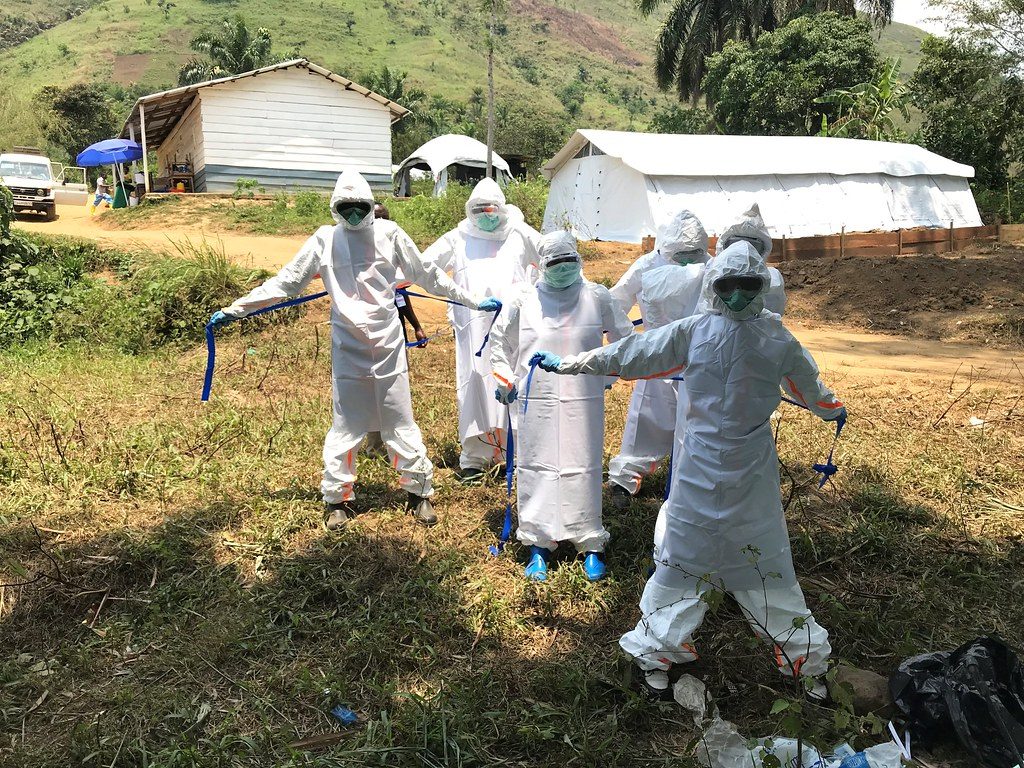
A doctor who caught Ebola while treating patients in eastern Democratic Republic of Congo has described his recovery, as the outbreak that infected him has killed 5,400 people and infected 11,000 — the second-most deadly ever recorded.
Dr Raymond Kasereka Kamwanga, 30, works at Katwa Hospital in Butembo, the city in North Kivu province that the Congolese health ministry identifies as the epicentre of the crisis, with the highest number of reported cases. He fell ill in July, two months after the World Health Organization declared the outbreak a public health emergency of international concern, and is one of 3,031 people who have recovered.
He believes he contracted the virus through contact with a patient in a setting where protective measures are not always adequate. The first symptoms came gradually: a bitter taste in his mouth, headaches and a general feeling of malaise. He contacted the Ebola response team and, after tests, returned home, but his condition did not improve.
Butembo does not have the equipment to test quickly for Ebola; samples must go to Beni, 54km north, and the condition of roads in this war-torn part of the country means the journey can take between 48 and 72 hours.
After three days at home he felt extremely weak and had muscle pain. On the fourth day he began vomiting and had diarrhoea, and told his family he had to go to the treatment centre. His mother, Masika Ndungo, 50, wept. "Why are you choosing to die at the Ebola treatment centre?" she asked him.
Around 18:00 he set off on foot but refused the main entrance, calling colleagues to put on protective gear before they approached and isolated him. The virus spreads from one person to another by contact with infected bodily fluids.
The outbreak is caused by the Bundibugyo species, for which there is no approved vaccine or treatment. Care is symptomatic: in his case, severe vomiting and diarrhoea. He spent 13 days in a hospital bed.
Even a certificate showing he was Ebola-free did not immediately dispel unease. For 21 days, the incubation period, he lived separately in another part of the crowded family home, where at least 18 people were staying, including children and people displaced by recent fighting. "We welcomed him home warmly. But because of our fear, we didn't get close to him any more," Ndungo said.
Kamwanga began writing a book, The Price of Saving Lives, one week after leaving hospital, and uses the draft in community outreach, distributing photographs taken while he was sick to convince residents that Ebola is real. "As someone who has recovered, I am living proof that the disease exists," he said.
Sources — how we know this
- PrimaryBBC World News