This story is currently available in anglais only — a translation isn't ready yet.
Eight unions in France call a strike for November 17, 70,000 police officers to be deployed
Eight unions say 1.6 million people (police: 575,000) took to the streets on November 5; the new day of action will be held in Paris, Marseille, Lyon and 26 cities.
ℹ️ Lecture par le navigateur · voix studio IA bientôt
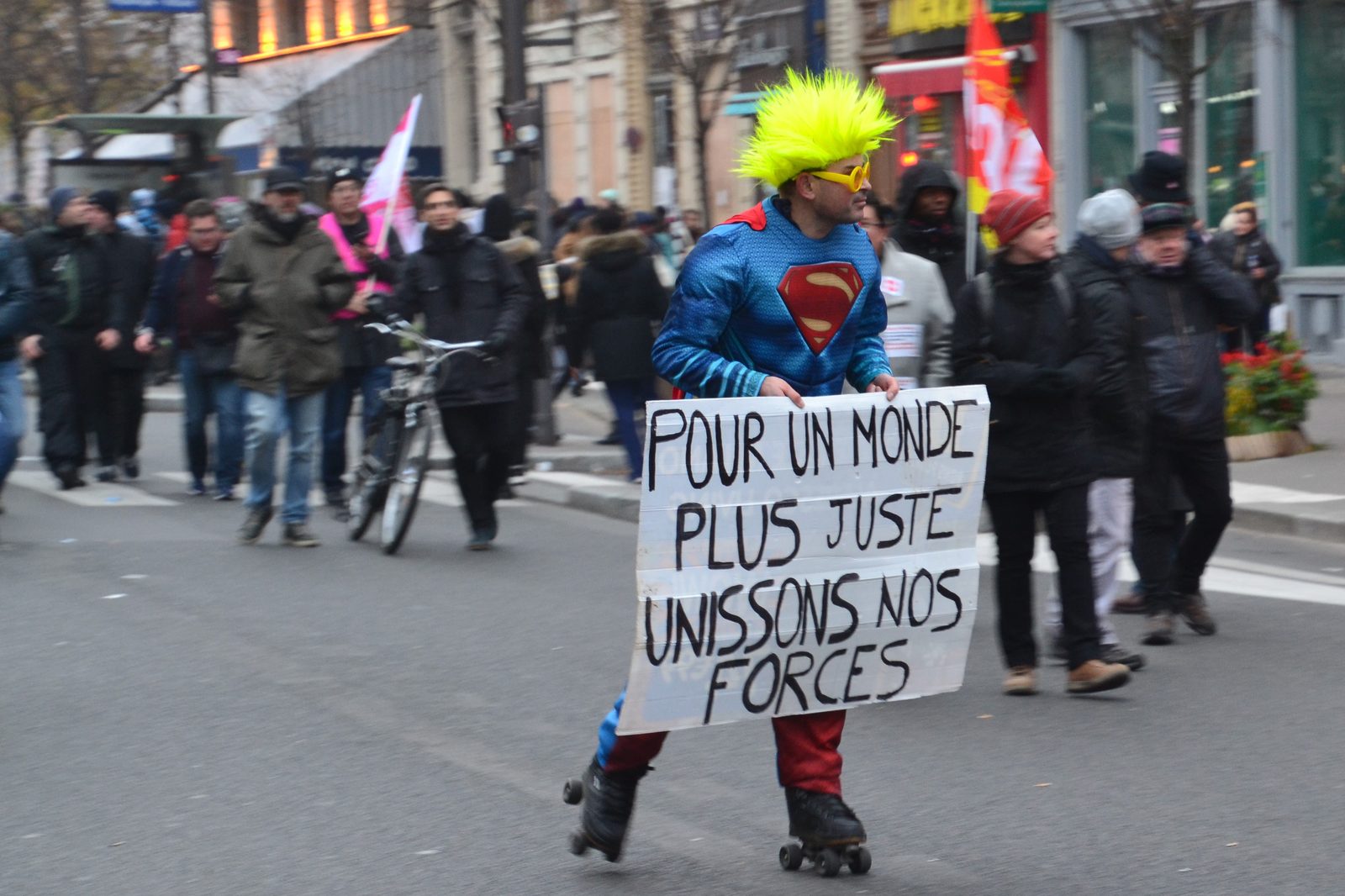
Eight unions in France have called a new day of strikes and demonstrations for Tuesday, November 17; the unions expect the action to resemble that of November 5. On that day, according to the unions' figure 1.6 million people, and according to the police figure 575,000 people, took to the streets in large and medium-sized cities.
The call came mainly from public sector unions covering more than 5.8 million employees: education at every level, hospitals, transport, communications, state radio and television, general administrative staff and municipal services. There is also movement within the police and fire services, and preparations for action among high school and university students.
The Yellow Vests movement has also announced that it will join the November 17 action. Benjamin Lacaze, from the movement's coordination, said, "On the 17th we will be with the unions." The Yellow Vests will also this year mark the ninth year of their movement, which began in opposition to fuel price increases.
The eight unions have set up a joint coordination to discuss logistics such as demonstration routes and security with the authorities, and have called on the private sector to join as well. The government has held a series of meetings with union representatives since the previous day of action and has put forward offers that do not reach the minimum threshold of the demands.
The joint demands include fighting the cost of living, protecting purchasing power, improving public services and raising the minimum wage. The unions want an increase indexed to inflation, which reached 3.5 percent at the end of October. Public sector unions are demanding the removal of a wage index freeze that has lasted four years; the unions reject the government's offer to raise the minimum wage by 25 euros to 1,502 euros.
CGT General Secretary Sophie Binet said, "The government is offering us only crumbs." Force Ouvrière and the confederation close to the socialists also argue that the offers do not constitute "serious progress."
Student unions are not convinced despite their talks with the education minister, the prime minister and President Emmanuel Macron. Their demands include substitute teachers, improving the financial and logistical conditions of high schools, abolishing the university guidance platform Parcoursup, 250,000 university places in technical and science fields, and 10 billion euros allocated to education.
The demonstrations will be held in 26 cities including Paris, Marseille and Lyon, as well as Bordeaux, Strasbourg, Nantes, Lille, Grenoble, Toulouse, Rennes, Perpignan and Carcassonne. In Paris, the union coordination requested a route between Invalides and Place d'Italie; the police prefecture proposed the stretch between Place d'Italie and Place de la Nation.
Interior Minister Laurent Nunez is expected to deploy a large security force backed by special intervention units and soldiers; at least 70,000 security personnel were deployed in recent actions. The authorities will apply measures such as the closure of numerous metro stations and searches near demonstration starting points.
With France's debt approaching 3.6 trillion euros and its annual interest burden approaching 80 billion euros, the economy's contraction in the third quarter is narrowing the government's room for manoeuvre. The government is confident that the student movement is weakening and that it is keeping the security situation under control; on Saturday, security units counted 106,000 demonstrators nationwide and student unions counted 200,000.
Sources — how we know this
- PrimaryAsharq Al-Awsat