This story is currently available in anglais only — a translation isn't ready yet.
Riyadh Is Not Importing the Agenda Anymore
As Boulevard World opens and Expo 2030 locks in a US partnership, the Gulf is no longer luxury's eager audience — it is authoring the script.
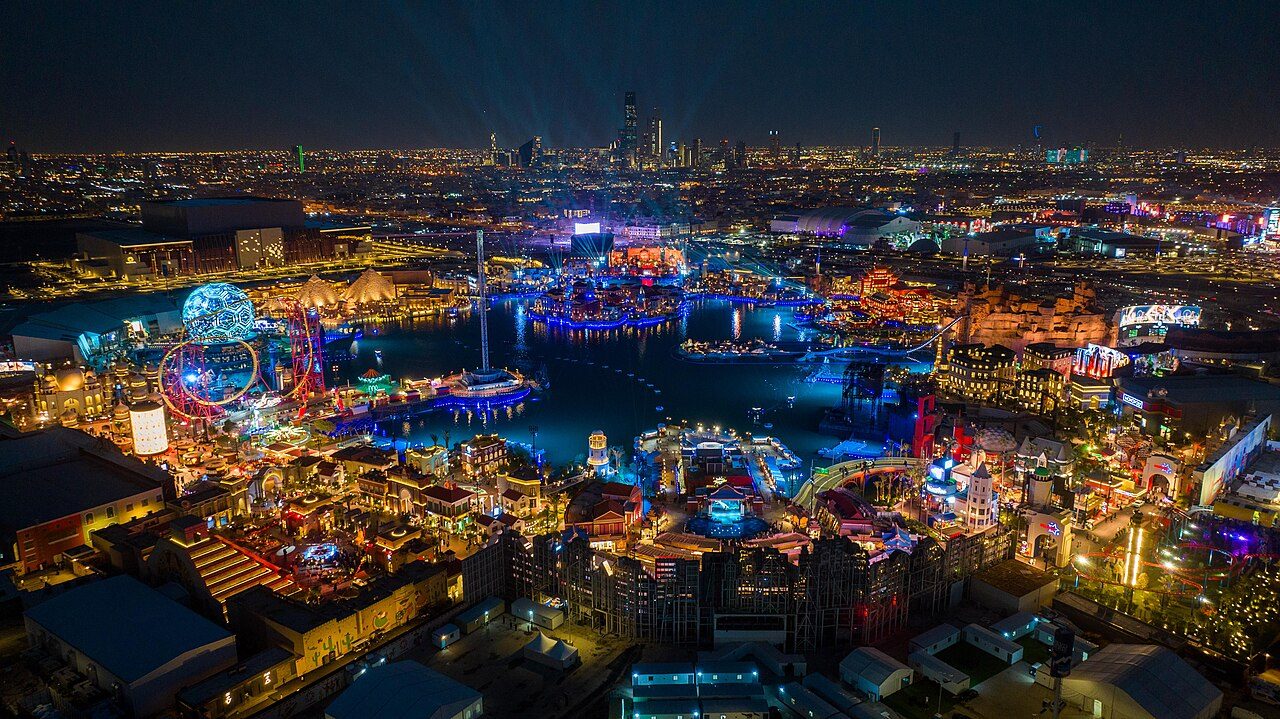
Picture the coat rack at Boulevard World's French zone. Beside it, a rack in the Japanese quarter. Across the lake, a Morocco pavilion where artisans demonstrate zellige tilework next to a pop-up selling Levantine embroidery. Now pull back far enough to see all seventeen cultural zones at once, arranged like a living mood board inside a single Riyadh destination — and ask yourself who, exactly, is curating whom.
Boulevard World opened Friday as part of the seventh edition of Riyadh Season, returning for its seventh consecutive year. On paper it is an entertainment complex. In practice it is a thesis about cultural ownership: that a Gulf capital can hold France, Japan, South Korea, Mexico and seventeen other national identities inside one envelope, price them all the same, and invite the world to come visit on its terms. My reading is that this is one of the most consequential gestures in the global luxury-cultural economy right now — not because of what it displays, but because of who controls the display.
The industry mechanic worth naming is this: luxury has long organized itself around pilgrimage. You go to Milan for ready-to-wear, to Paris for couture, to Tokyo for streetwear subculture. The consumer travels toward meaning. Boulevard World inverts that logic entirely. The cultures come to Riyadh. They arrive as zones, as architecture, as restaurant menus and live performances, all ticketed through a single platform, all experienced without a connecting flight. It is, structurally, what a luxury conglomerate does when it acquires heritage brands — it absorbs distinct identities into one portfolio and manages the narrative from the top.
That portfolio logic extends beyond entertainment. On the same day Boulevard World opened, a formal participation agreement for Expo 2030 Riyadh was signed between Saudi Arabia and the United States in Atlanta. US Secretary of State Marco Rubio described the expo as 'an important platform to advance American innovation' and strengthen strategic partnership. Note the grammar: American innovation will be advanced — on Saudi soil, on a Saudi timeline, within a Saudi framework. The Saudi ambassador, Princess Reema bint Bandar, described it as a milestone in a 'longstanding relationship.' Diplomatically polite. But fashion readers understand this language from another context: it is exactly what a powerful house says when a collaborating label needs the platform more than the platform needs the collaboration.
The cultural thesis behind all of this, if I had to name it plainly, is sovereignty-as-hospitality. The Gulf is not closing its borders to foreign aesthetics — it is opening them so wide, and on such advantageous terms, that the power dynamic quietly reverses. You are welcome here. We set the hours.
This matters for fashion specifically because the industry has spent two decades treating Gulf consumers as the destination for its excess — the clearance valve for unsold couture seasons, the reliable buyer when European demand softened. A recent industry read noted that the region is 'no longer the luxury bright spot it was at the start of the year,' acknowledging volatility in a market brands had started to take for granted. What Boulevard World and Expo 2030 together suggest is that the region's ambitions have simply outgrown the role brands assigned to it. It was never going to remain a perpetual import market.
The design language of a destination like Boulevard World borrows from everywhere and answers to one address. Zellige beside sushi beside a Vuz Dome cinema offering 360-degree immersive screenings — this is curation as geopolitical statement. The covered abaya sold in the Saudi quarter sits alongside a French patisserie without hierarchy, without the editorial ranking that a European luxury house would impose if it were staging the same multicultural moment. Covered dress and croissant occupy the same square footage. Neither is explained to the other.
That is the grammar of modest dressing done right, incidentally — not a concession made to a market, not a special section at the back of the store, but an organizing principle that structures the entire space around the assumption of its legitimacy. Boulevard World does not have a 'modest fashion corner.' It has an architecture in which covered women designed the brief.
What I cannot yet read clearly is whether this curatorial authority translates into creative production — whether Riyadh Season mints new designers, new fabrics, new ideas, or whether it remains the world's most ambitious retail theatre. The Expo 2030 framework, with its stated emphasis on innovation and economic opportunity, suggests ambition in that direction. The signing happened in Atlanta, the agreement was formal, the language was partnership — but the venue for that partnership is Riyadh, and the timeline belongs to Riyadh.
The tension worth watching into next season: will the brands and designers who show up for Expo 2030 arrive as collaborators with genuine creative stakes, or as exhibitors paying for square footage in someone else's vision? The answer will tell us whether the Gulf's cultural programming has moved from platform to patron — and whether the rest of the industry has noticed the difference yet.