This story is currently available in anglais only — a translation isn't ready yet.
SpaceX catches Starship in mid-air for the first time
On the 15th test flight of the world's largest rocket system, Starship was held in mid-air by mechanical arms at Starbase in Texas after its 22-hour journey.
ℹ️ Lecture par le navigateur · voix studio IA bientôt
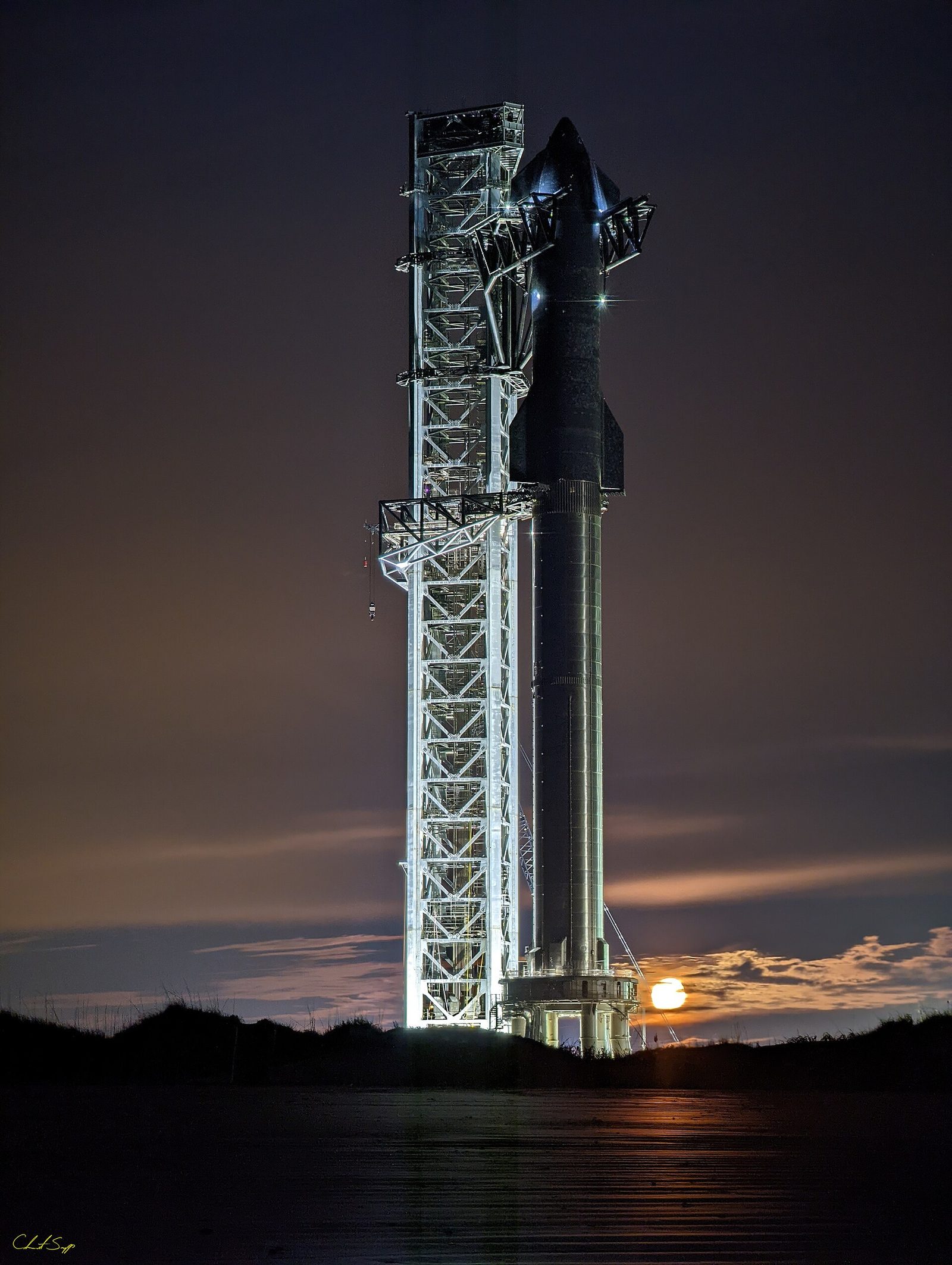
SpaceX caught a spacecraft in mid-air for the first time on Saturday. After surviving the extreme heat of atmospheric reentry, Starship emerged from the clouds, descended slowly over Starbase in south Texas and slid smoothly between the mechanical "chopstick" arms above Launch Pad 2.
According to AFP, SpaceX spokesperson Dan Huot said, "This was the Holy Grail of spaceflight," and said it fell through fire and was caught in steel in the air, that they had caught a Starship, and that everything had now changed. The crowd outside Starbase erupted as the vehicle came into view; on the company's official livestream, the final descent was accompanied by the 1977 track "Baby Come Back."
In the mission, the 15th test flight of the world's largest and most powerful rocket system, Starship made 14 laps in Earth orbit during its 22-hour journey and deployed 26 satellites for Musk's Starlink internet constellation. SpaceX had previously caught returning booster rockets three times; however, catching Starship was more complex because the vehicle falls much faster and from a much higher altitude than the boosters.
Musk wrote on X, "I hugged Ship 42 on its return," and shared footage shot from different angles, saying the vehicle "looks great." Aviation expert Clayton Swope of CSIS described the mission as "a tremendous technical achievement" and said, "It proves the whole idea that Starship can operate as a fully reusable spacecraft"; he said he wanted to see how quickly they could repeat it. Analyst Kathleen Curlee of Georgetown University's Center for Security and Emerging Technologies said SpaceX's need was "many repeated successes," which would prove the capability is ready to carry sensitive payloads and missions.
NASA Administrator Jared Isaacman described the catch as "almost magic" and wrote on X, "It creates more believers every day... one step closer (to the Moon)." NASA expects to use Starship as the lunar lander in the Artemis mission.
Musk sees Starship as the workhorse of "rapidly reusable" rocket systems and predicts that within three to four years Starship launches will take place more than once an hour. But the project is beset by delays; the problem of transferring fuel in orbit remains unresolved. The Super Heavy booster experienced a technical problem during landing on Friday and had to land in the Gulf of Mexico instead of being caught by the "chopstick" arms.
SpaceX is investing heavily in production and launch capacity after raising about 85.7 billion dollars in its June IPO. Company officials told reporters touring the 93,000-square-meter factory at Starbase that they could produce a spacecraft every two weeks and a booster every four weeks.
Sources — how we know this
11 independent sources corroborated this
- PrimaryAsharq Al-Awsat (EN)
- CorroboratingAnadolu Ajansı (TR)
- CorroboratingMeduza
- CorroboratingRBC
- CorroboratingTengrinews
- CorroboratingHacker News Front Page
- CorroboratingLe Monde
- CorroboratingK-News
- CorroboratingTRT Haber
- CorroboratingCumhuriyet Gazetesi
- CorroboratingDaryo