This story is currently available in англійська only — a translation isn't ready yet.
Rosatom completes components of El-Dabaa's first reactor weighing 340 tons
Manufacturing of the head and internal components of the first unit at the Izhora complex and their transport to Matrouh... and operation of the first reactor in early 2028
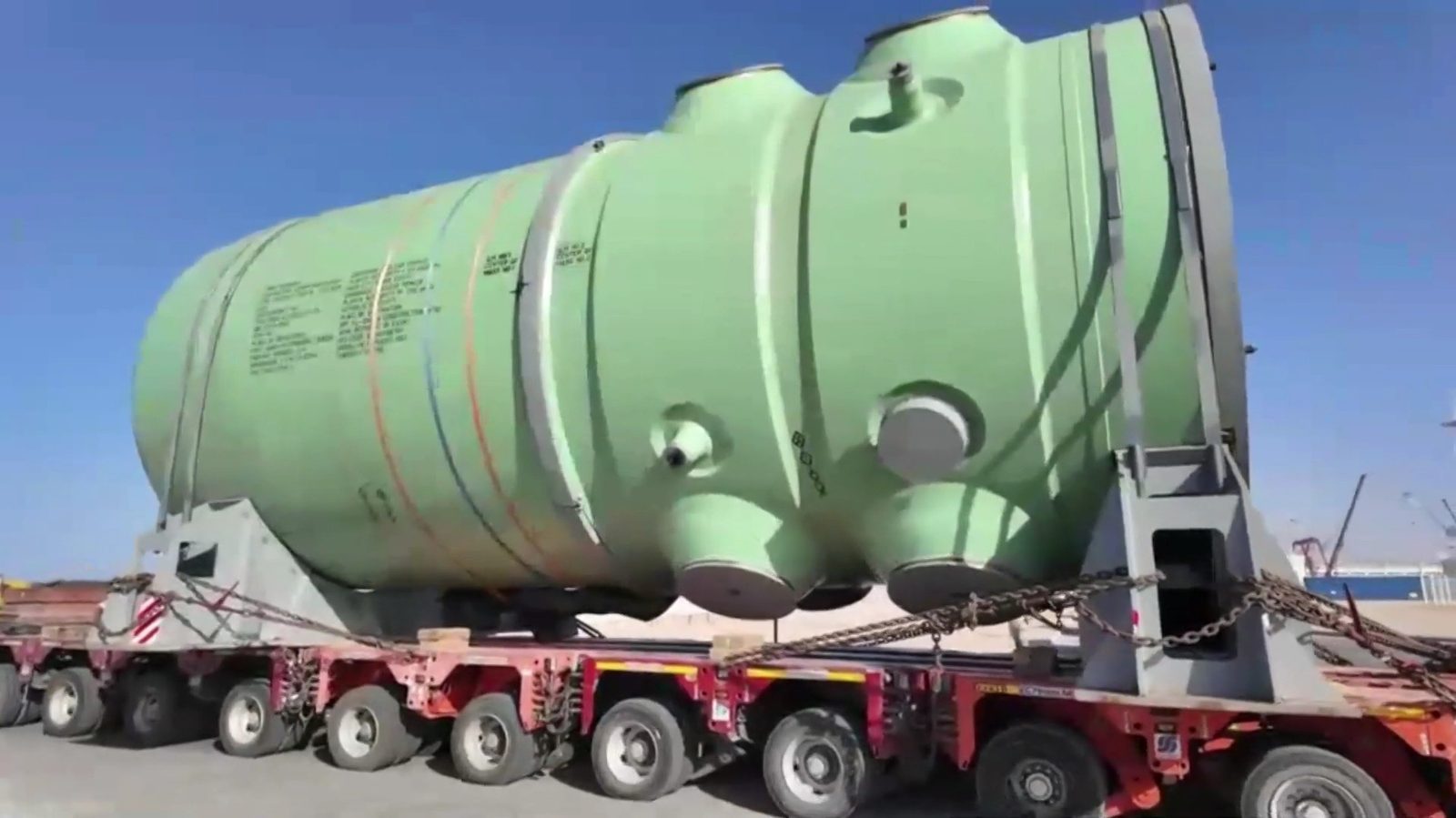
Russia's Rosatom State Nuclear Energy Corporation announced on Tuesday the completion of manufacturing of the internal components and the reactor head of the first unit at the El-Dabaa nuclear plant in western Egypt, of the VVER-1200 type, in a step that paves the way for installing the rest of the reactor building's equipment and moving on to the testing and operation phases.
The company said the manufacturing work was completed at the Izhora complex, affiliated with its machine-building division, in the Russian city of St. Petersburg, explaining that the internal components and the head are among the main parts responsible for ensuring the reactor's safety and operational efficiency. The total weight of the components scheduled to be transported to Egypt is about 340 tons, while the total weight of the reactor exceeds 670 tons when the main pressure vessel, which was previously manufactured and installed on site, is counted.
Manufacturing of the pressure vessel for the first unit's reactor began at the Izhora complex in September 2025, before it was transported and installed at its designated site at the El-Dabaa plant in November of the same year.
The plant, located in Matrouh Governorate, consists of four units with a capacity of 1,200 megawatts each, with a total production capacity of 4,800 megawatts, and relies on Russian pressurized water reactors of the VVER-1200, Generation III+ type, according to the Ministry of Electricity. Operation of the first reactor is scheduled to begin in 2028, followed by the other reactors successively in 2030, according to Egyptian government estimates.
Ali Abdel Nabi, former deputy head of the Egyptian Nuclear Power Plants Authority, said that progress in implementation reflects the Russian side's commitment to its pledges regarding supplies and manufacturing despite Moscow's preoccupation with the repercussions of the war in Ukraine. He explained that installation of the core catcher and the pressure vessel has been completed, along with the four steam generators, and that the next phase includes connecting the pressure vessel to the steam generators and installing the pressurizer, followed by cold pressure tests and then hot tests, leading up to opening the pressure vessel to load nuclear fuel.
He added that commissioning tests, which involve raising the reactor's power at different percentage levels, continue for between 7 months and a year, before the plant is handed over and commercial electricity supply to the grid begins.
Electricity Minister Mahmoud Esmat said, in a meeting of the Energy and Environment Committee at the House of Representatives, that the plant will add 4,800 megawatts of clean energy to the national grid around the clock without being affected by climate fluctuations, and that the project saves 7,902 million cubic meters of natural gas annually, with a value reaching up to $4 billion amid rising global gas prices.
The two sides signed a cooperation agreement to establish the plant on November 19, 2015, at a cost of $25 billion, which Russia provided to Egypt as a concessional government loan, and the final construction agreements were concluded in December 2017.
Abdel Nabi linked global energy security to the crises witnessed by vital shipping lanes such as the Strait of Hormuz and Bab al-Mandab, saying that traditional reliance on storing gas or petroleum faces enormous cost obstacles and vast storage spaces, and that "nuclear plants offer the optimal solution for modern energy security," since nuclear fuel sufficient to operate the units for 7.5 years can be stored in a small space.
Sources — how we know this
- PrimaryAsharq Al-Awsat
Energy Portfolio
Check your broker for the latest on energy stocks.
View Now →