This story is currently available in англійська only — a translation isn't ready yet.
China Drills Harder as the Iranian Discount Vanishes: Beijing Rebuilds the Floor Under Brent
Chinese refiners ran 13.99 million bpd in September against 4.43 million bpd of domestic output. The gap is now the story.

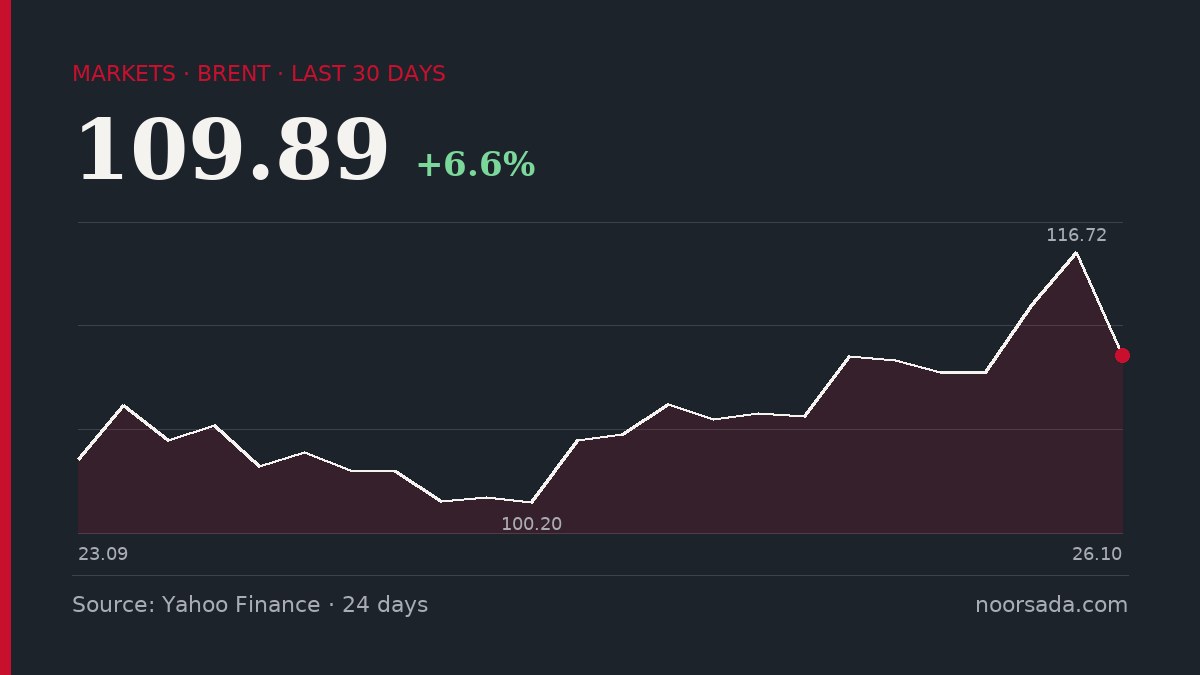
Chinese refiners processed 13.99 million bpd of crude in September, according to official Chinese data cited in regional energy press. Domestic wells delivered 4.43 million bpd. Imports covered 9.03 million bpd. The remaining 530,000 bpd came out of storage — the fourth monthly drawdown in five. That is the operational picture Beijing is now trying to change by directive, and it is the number that matters more than any communiqué out of the Gulf this week.
On 21 October the National Energy Administration told PetroChina, Sinopec and CNOOC to raise production capacity, lift investment and accelerate the build-out of national supply bases. The language was crude up, gas up faster. The cause is not mysterious: by early October, independent tanker-tracking estimates cited in regional energy press had Iranian floating storage available for Chinese delivery falling under one million barrels and then running out. The discount barrel that independent refiners in Shandong have run on for years has, for now, stopped arriving.
My reading is that Beijing has spent most of 2026 running a two-handed trade. One hand drew down commercial and strategic stocks built when crude was cheap — onshore inventories sat near 1.192 billion barrels in the week to 19 October, down 162 million from the May record but only 13 million below the same week last year, on the inventory series cited in regional energy press. The other hand cut spot buying hard: June imports ran about 4.4 million bpd below the 2025 average on the same source basis. That is a physical move, not a financial one, and it is the single largest reason the global balance has not been tighter still.
Now the arithmetic turns. If the Iranian channel is gone and the stockpile has done roughly a 160-million-barrel shift in five months, Chinese buyers have two options: pay the going price for Atlantic Basin and Gulf grades, or produce more at home. The directive says do both. The physical ceiling on domestic Chinese crude growth is low — the mature fields in the northeast do not surge, and offshore Bohai and the South China Sea add tens of thousands of bpd per project, not hundreds. The incremental Chinese crude available over a year, if the capex lands quickly, is a modest fraction of the Iranian hole. Gas is a different conversation.
Set that against the ledger elsewhere. US weekly crude output printed 13,269 thousand bpd on 16 October, down 410 thousand bpd week on week — a 3.00% drop on the EIA weekly series, which is not a rounding error in a market this tight. Cushing stocks rose 987 thousand barrels to 27,594 thousand, still thin by any five-year reference. US distillate stocks climbed 1,675 thousand barrels to 104,286 thousand, which is the one soft spot in an otherwise taut picture, and it matters because diesel is the fuel the Iran disruption has stressed hardest. Brent spot, on the EIA's lagged daily series, sat at $115.22 on 20 October, off $3.60 on the week. The pullback is financial positioning around the midterm calendar in Washington, not a change in molecules.
The map in words: Iranian barrels that used to move from Kharg to Shandong via offshore ship-to-ship are not moving. Russian flows into China by pipeline and ESPO cargoes are. West African and Brazilian grades are being pulled east at a premium. Saudi term barrels are honouring contracts. The Strait of Hormuz is still open. The Red Sea diesel route is not what it was. Into that geography, Beijing is now pouring domestic capex because imports are no longer a cost problem — they are an availability problem.
What does this do to the price floor? It raises it. Most of the models I have seen priced for 2026 assumed Chinese buying would re-emerge at some level well below current Brent as inventories thinned. The NEA directive signals that Beijing would rather drill marginal domestic wells, at whatever breakeven the geology forces, than bid aggressively into a tight seaborne market. That is a bid the market was counting on and will not fully get.
The kicker is capacity. China cannot replace the lost Iranian volumes from its own basins next quarter. Nobody can. What it can do is keep the stockpile from collapsing while global spare capacity — concentrated in two Gulf producers — decides what it wants Brent to cost into the northern-hemisphere winter. The floor is being rebuilt in Daqing and Bohai, not in Vienna.