This story is currently available in англійська only — a translation isn't ready yet.
Istanbul's giant open-air cisterns draw attention with their 150-metre by 150-metre dimensions
Art historian Hayri Fehmi Yılmaz said the three large cisterns in Fatih date to the 5th century and have no equivalent anywhere in the world.
ℹ️ Озвучка браузером · студійний голос ШІ незабаром
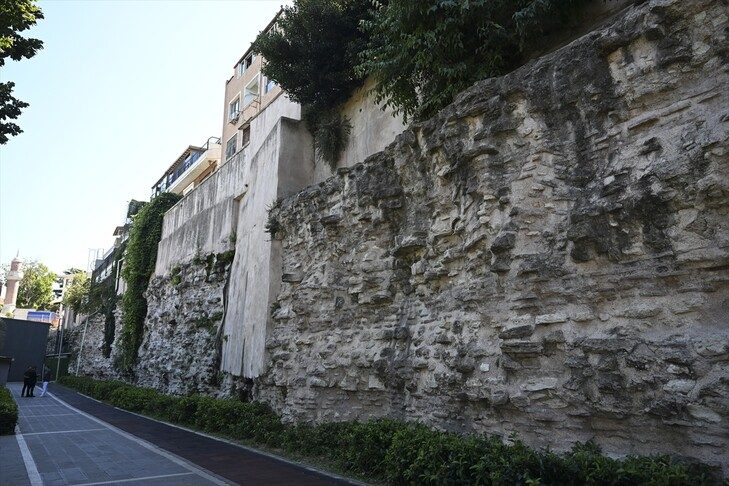
Anadolu Agency examined Istanbul's open-air cisterns, the witnesses to the city's more than 1,000-year water storage tradition, in a feature package headlined "Witnesses of Istanbul's Water Civilization: Cisterns". Because the water sources on the Historic Peninsula were insufficient, lines carrying water into the city from outside were built during the Byzantine Empire; to store the water brought in, a large number of covered cisterns were built along with open-air cisterns surrounded by enormous walls. Three of these large structures, which in time also came to be called "çukurbostan" because crops were grown inside them, survive to the present day in Fatih, and one in Bakırköy.
Art historian Hayri Fehmi Yılmaz told the AA correspondent about the history, architectural features and changing patterns of use over time of the open-air cisterns of Aetios in Karagümrük, Aspar in Yavuz Selim, Hagios Mokios in Fındıkzade and Fildamı in Bakırköy. "The cistern that Yavuz Selim sits inside is of gigantic dimensions, 150 metres by 150 metres," Yılmaz said, stating that the three large cisterns in Fatih date to roughly the 5th century. "There is no equivalent of such large cisterns in world architecture," Yılmaz said, adding that cisterns on this scale are not encountered in large cities in Europe or Asia and that this is unique to Istanbul.
The Aetios Cistern is estimated to have been built during the reign of Emperor Theodosius II. The area, which served as a vegetable garden during the Ottoman period, is today the site of Vefa Stadium; this structure, built in 1926, now hosts football matches under the name "Karagümrük Stadium". The Aspar Cistern, built by General Aspar during the reign of Leo I, is popularly known as the "Yavuz Sultan Selim Cistern"; the Fatih Municipality Yavuz Selim Life Centre built inside the cistern has for years been used by the neighbourhood's residents as a social space. The Hagios Mokios Cistern, also known as the "Altımermer Çukurbostanı", was built by Anastasius I; today the Fındıkzade Çukurbostan Life Centre stands on the site. The Fildamı Cistern, which met the water needs of the Magnaura Palace and its surroundings in the 5th and 6th centuries, at one time housed the army's elephants, and the structure today hosts certain cultural events.
Yılmaz recounted that a researcher had argued that these structures might not be cisterns but military installations, on the grounds that no trace of the hydraulic plaster needed to hold water is visible on the existing walls and that it has not been resolved how evaporation would be prevented in the summer season. Stating that the cisterns were turned into vegetable gardens already in the Byzantine era, Yılmaz said they were used to grow fresh vegetables and fruit within the city, and that they continued as gardens during the Ottoman era as well.
Sources — how we know this
3 independent sources corroborated this
- PrimaryAnadolu Ajansı (TR)
- CorroboratingEkonomim (Dünya)
- CorroboratingNTV