This story is currently available in англійська only — a translation isn't ready yet.
Three Shocks, One Barrel: Iran at Zero, Volgograd Burning, U.S. Rigs Stuck at 463
Iranian loadings have been dark since August 25. Ukrainian drones have hit at least eight Russian refineries since October 30. U.S. oil rigs will not move.

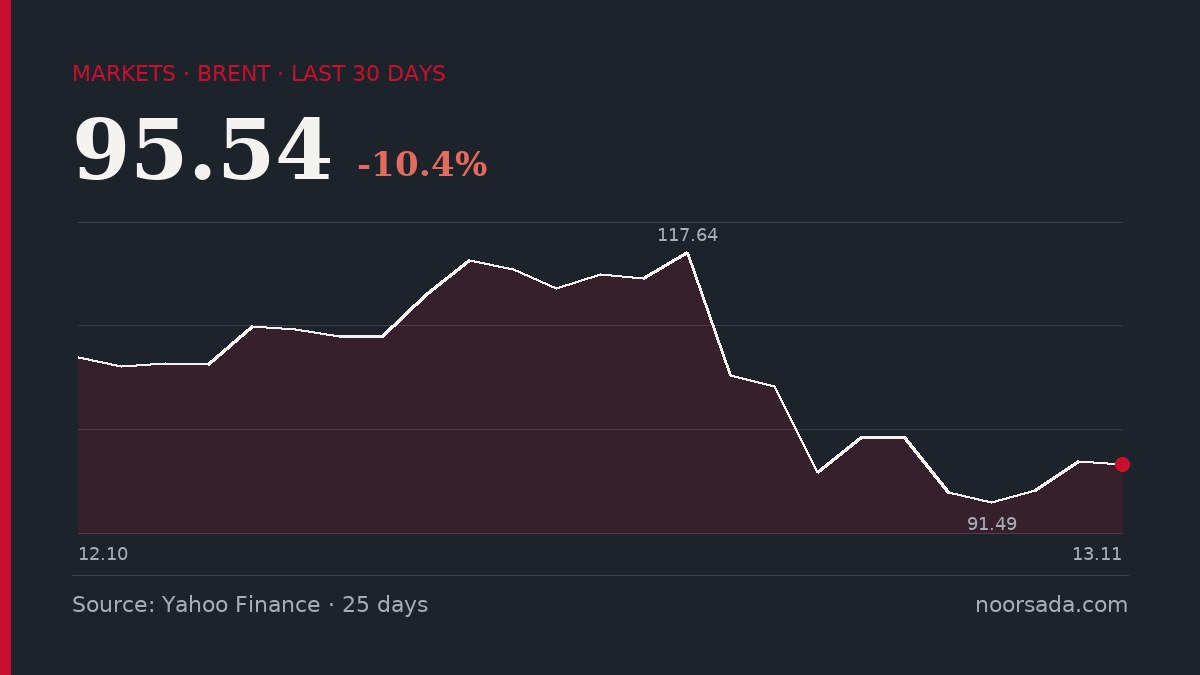
Iran has loaded no crude since 25 August. That is the load-bearing fact on the global supply ledger this week, and it is the one most traders are still underweighting.
The U.S. Treasury number, cited in the source package, is unambiguous: zero loadings since late August. The floating stockpile Iran held outside the American naval blockade — 88.8 million barrels in mid-July — was drawn down to nothing by mid-October. Another 43 million barrels sit stranded inside the blockade zone and cannot move. Kpler's working estimate, as reported by the lead wire, is that Chinese payment lags of one to two months mean the cash stops arriving around mid-December. Tehran is now drafting its 2027 budget on the assumption that oil revenue could go to zero — a planning posture, not yet a reality, but the planning posture tells you what the Islamic Republic itself thinks the physical picture looks like.
Pre-war Iranian output was 3.59 million barrels per day in February. Kpler now puts production at roughly 1.8 million bpd in the months before late October. OPEC's own latest monthly figures, per the lead wire, have Iran at roughly half its pre-war level. Call it a disappeared 1.5 to 1.8 million bpd from the seaborne market, depending on which month you anchor to. That is the first shock.
The second shock is further north, and it is to refining, not to crude. Four workers were killed on Friday morning when Ukrainian drones struck the Lukoil refinery at Volgograd — a facility with roughly 14.8 million tonnes per year of crude processing capacity, according to the regional outlet that identified the site. Ukraine's General Staff counts this as at least the eighth Russian refinery hit since 30 October, including five of the country's largest. Russia's defence ministry said it intercepted 1,198 drones overnight across Russian regions and Crimea. Some portion always gets through. The physical consequence is not a shortage of Russian crude — that still loads at Primorsk, Novorossiysk, Kozmino — but a shortage of Russian product. When Russian refining capacity is forced offline, more Urals crude goes to the export market at a widening discount. The regional press reports Russian discounts are now at a three-year high, with Persian Gulf barrels competing directly for the same Asian buyers.
That is the map in words. Iranian barrels off the market. Russian crude backing up behind damaged refineries and pricing aggressively to clear. Gulf producers lifting into the gap.
Now the third shock, which is the one that refuses to arrive. U.S. active oil rigs sat at 463 this week, unchanged. Total rigs fell to 601. Weekly crude production nevertheless printed a third consecutive record at 14.013 million bpd for the week to 6 November — up 151,000 bpd year-on-year, which is a small number by shale's historical standards. The frac spread count is at 195 crews. The rig line is flat; the output line is still creeping up on efficiency gains and DUC drawdowns. My reading is that American shale is now a plateau business, not a swing producer. It will not fill a 1.5 million bpd Iranian hole on a six-month timeline. It probably cannot fill it at $90 Brent either, because the capital discipline the equity market imposes is tighter than the price signal.
So the question the desk asked — how much structural disruption can the market absorb before OPEC+ loses control of the price narrative — has a physical answer rather than a political one. OPEC+ keeps the narrative only so long as Gulf spare capacity covers the Iranian gap and Russian product disruption stays contained within Russia's own domestic fuel balance. The Saudi–UAE–Kuwait–Qatar bloc, per the lead wire, would prefer the status quo. The status quo requires them to pump. Al Eqtisadiah, on YouTube on 12 November, argues that an OPEC+ increase above two million bpd would intensify competition and pressure prices lower. That is the financial read. The physical read is the same barrels, sold into a market where the Iranian seller is absent and the Russian seller is discounted.
What moves next quarter is Gulf spare capacity and Russian refining repair times. Everything else is commentary.