This story is currently available in англійська only — a translation isn't ready yet.
Turkey and Qatar Sign Joint Defense Agreement, Target $5 Billion in Trade Exchange
The two countries emerged from their twelfth strategic meeting with a joint position on Iran and Gaza, without disclosing implementation mechanisms.
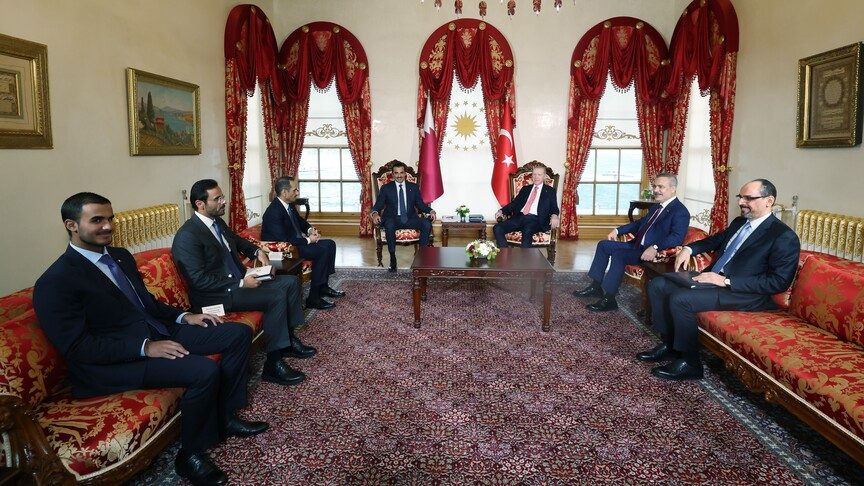
Turkey and Qatar signed a joint defense agreement aimed at strengthening collective defense and establishing a unified position in the face of external armed attacks, on the sidelines of the twelfth meeting of the Turkish-Qatari Supreme Strategic Committee, held in Istanbul under the chairmanship of Turkish President Recep Tayyip Erdogan and Qatar's Emir Sheikh Tamim bin Hamad Al Thani.
The text of the joint statement issued by the meeting stated that the agreement "reflects the signatories' commitment to safeguarding their sovereignty and territorial integrity, as well as their shared vision to contribute to a more secure and stable regional order." The two countries also welcomed the signing of the Badr Memorandum, which Turkey, Qatar, Pakistan and Indonesia have joined, describing it as a step toward strengthening self-defense capabilities through joint production and technology exchange.
On the economic front, the two countries affirmed their goal of raising the volume of trade exchange to $5 billion, and noted that Turkish contracting companies have carried out 206 projects in Qatar with a total value of $20.8 billion. The statement also reviewed the trade and economic partnership agreement signed in 2018 and in force since the first of August 2025.
On the Iranian file, the two countries called for resolving the American-Iranian dispute through dialogue and diplomacy, noting the importance of understandings between Washington and Tehran or reaching a new agreement that guarantees de-escalation. However, the statement did not include any position on the nature of these understandings, nor on the mechanism of potential pressure on the two parties.
The statement stressed the need to provide full and safe humanitarian access to Gaza, and demanded the immediate and unconditional release of humanitarian workers and detained United Nations staff. The two countries also condemned Israeli settlement activity and acts of violence in the West Bank, and supported the establishment of an independent Palestinian state on the borders of the fourth of June 1967 with East Jerusalem as its capital.
Sources — how we know this
4 independent sources corroborated this
- PrimaryAnadolu Agency (EN)
- CorroboratingAl Jazeera English
- CorroboratingFrance 24 (EN)
- CorroboratingHürriyet