هذا المحتوى متاح حالياً باللغة الإنجليزية فقط — الترجمة ليست جاهزة بعد.
Ushakov Opens the Door to Europe Because the Door to Kyiv Will Not Budge
A Kremlin aide concedes Washington cannot deliver Zelensky. The invitation to Brussels is less a thaw than a confession about Anchorage.
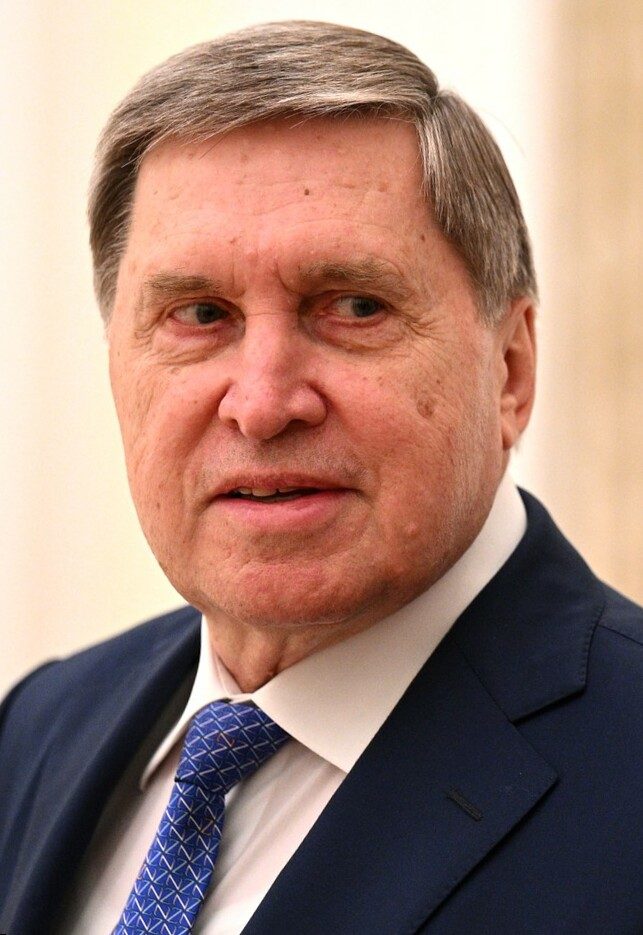
The admission came from Yury Ushakov, and it is the sentence worth reading twice: before Anchorage, it seemed the U.S. administration might be able to dictate something and force Kyiv to comply. But so far, this hasn't really worked out.
Translate the diplomat's euphemism and you get the architecture of the next six weeks. The Kremlin bet, in the summer of 2024, that a single handshake in Alaska would convert a sitting American president into a delivery mechanism for Ukrainian concessions. Fifteen months on, the aide who was in those rooms is on state television conceding, in the softest voice available to him, that the mechanism did not deliver. Hence the pivot: talk to the whole of Europe, which fully supports Kyiv.
My reading is that this is not generosity. It is arithmetic.
Moscow has run the numbers on what Washington alone can extract from Kyiv and found the figure too small. Volodymyr Zelensky, interviewed on Ukrainian television the same weekend, called the Russian offer of talks a possible political trick timed to the American midterms, and then — crucially — listed what he would actually accept: an energy ceasefire, maritime security on grain, an all-for-all prisoner exchange, a leaders' meeting. Territory, he said, is a red line that only principals can touch. Limits on the Ukrainian armed forces, he rejected outright.
That is a negotiating position that has hardened, not softened, since the summer. A Ukrainian president who in 2024 was fighting for his political life now speaks like a man who has priced the American pressure and found it survivable. The Kremlin has noticed. Ushakov's invitation to Europe is the acknowledgement.
Now the question the desk asked: does bringing Europe in fracture the coalition, or thicken it?
The honest answer is that it depends on which European capital answers the phone. London, Berlin and Paris have already said in public that they back a Zelensky-Putin track and expect a European role in whatever follows. That is a position that costs them nothing to state and quite a lot to execute. The execution is where the fractures live. A ceasefire with security guarantees means European troops, European money, European political cover for a line on a map that will satisfy no one. The three capitals that said yes in principle have not yet said yes in budget.
And then there is the eastern flank of the question, which is where Moscow's calculation gets more interesting. Belgrade this weekend produced its own text: the former Serbian president, speaking from the headquarters of his party after the Student List won the snap vote, predicted anti-Russian sanctions by March or April. The Student List itself has said it will do no such thing. But the direction of travel in a capital Moscow has spent a decade cultivating is now a matter of open argument in Belgrade, not quiet management from Moscow. The Kremlin's European bench is thinner than it was eighteen months ago, and the invitation to include Europe in talks is also, read sideways, an invitation to the Europeans still willing to be included.
The other frame around all of this is Beijing. Ushakov confirmed that preparations have begun for a trilateral on the sidelines of the APEC summit in China on November 18-19 — Putin, Xi, Trump. He also confirmed that a separate Putin-Trump meeting in Shenzhen has not been agreed. The sequencing matters. If the trilateral happens, it will be the first time since the Cold War's closing act that the three principals sit at one table with Ukraine as the explicit agenda item, and it will happen on Chinese soil, with Chinese framing, and with a Chinese host who has spent two years building the posture of the indispensable mediator. That is a geometry Moscow can live with and Washington cannot easily refuse. Whether Europe gets a chair in Beijing, or only a chair at the technical talks the Ukrainian president says will happen in Abu Dhabi in the first half of November, is the test of Ushakov's sincerity.
Here is what would prove my reading wrong. If, in the fortnight after Russia's National Unity Day on November 4, Moscow produces a draft text that moves on any of the four items Zelensky listed as acceptable — energy, grain, prisoners, a leaders' meeting without territorial preconditions — then the invitation to Europe is substance, not stagecraft. If instead the Russian delegation arrives in Abu Dhabi with the same maximalist package it carried to Anchorage, dressed in a European-friendly ribbon, then Ushakov's candour this weekend was the tell: the Kremlin has not changed its ask, only its audience.
The pattern across fifteen months suggests the second. The pattern can be broken. It usually isn't broken by the actor who just admitted his last plan failed.