This story is currently available in Αραβικά only — a translation isn't ready yet.
From the DIFC gate to the metro at Emirates Towers, the ADNOC Gas $8bn expansion reads differently at each stop when Iran is setting terms on the strait.
ℹ️ Ανάγνωση από τον περιηγητή · στούντιο φωνή AI έρχεται σύντομα

Start at the arch. The DIFC gate on Al Sa'ada Street is the most photographed piece of concrete in the emirate, and on a Sunday morning in August it is also the coolest spot outdoors that is not indoors. Stand under it and you can see, in one glance, three of the buildings that price the Gulf: the tower where the sovereign wealth allocators sit, the tower where the sukuk desks sit, and the tower where the commodity traders sit. This week they were all looking at the same headline, and none of them believed it for the same reason.
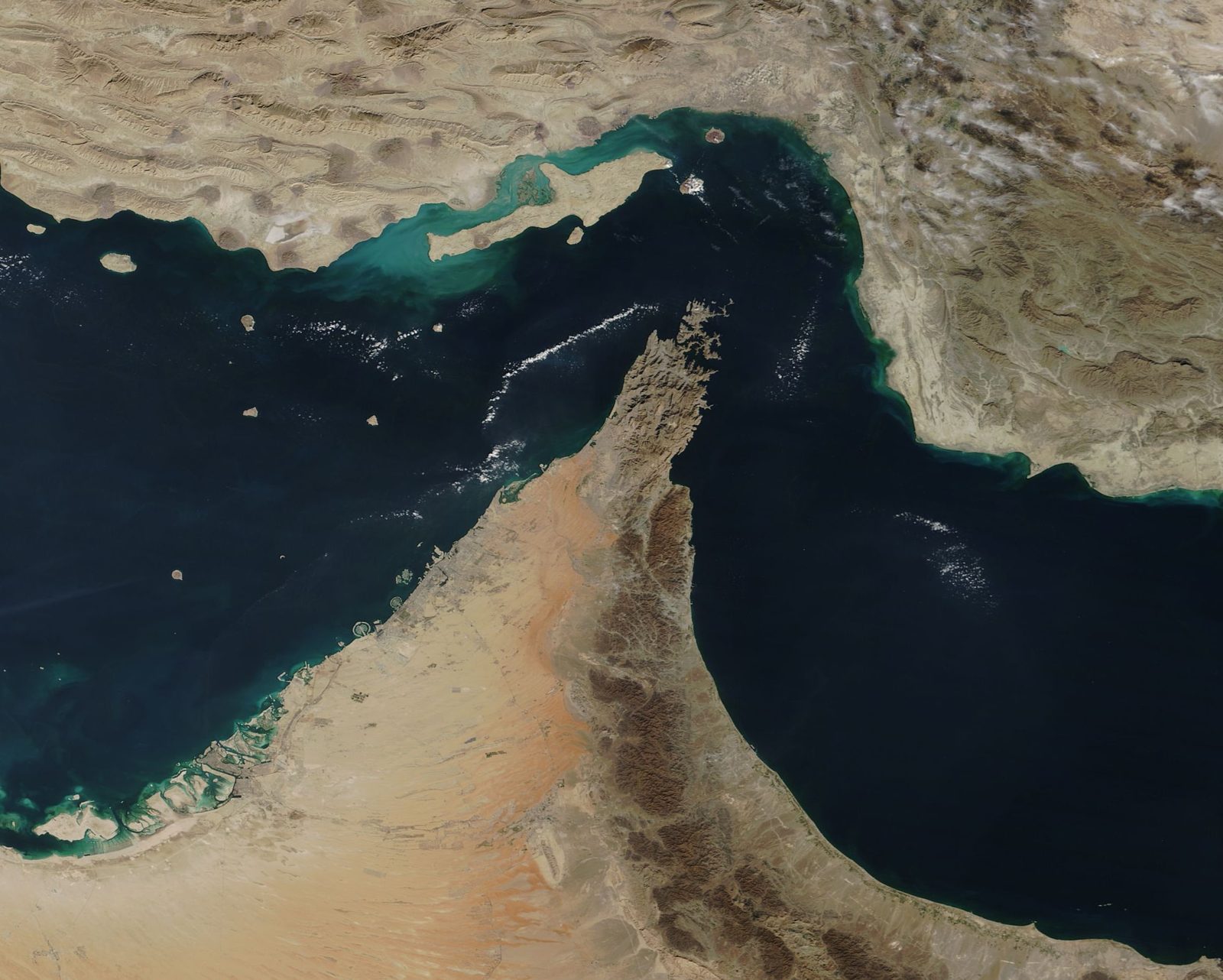
The headline: Iran has set conditions on the Strait of Hormuz. It will not, according to statements out of Tehran, be reopened to normal traffic until Washington 'corrects' its behaviour. In the same news cycle, the UAE confirmed one of its vessels had been targeted by airstrike, the Houthis claimed a hit on a Saudi refinery, and ADNOC Gas announced it would invest more than eight billion dollars in an expansion push. Four items. One waterway. Let us walk.
First stop, the arch itself. The dirham this week closed at 3.6725 to the dollar. The riyal closed at 3.7500. Those are not market prices in the sense a first-year textbook would recognise; they are policy commitments, defended by two central banks with reserve stacks large enough to make the defence credible for a very long time. What is remarkable is not that the pegs held — they were designed to hold through worse — but that the volatility around them, in the forward points and the option skews, was quieter this week than it was three weeks ago, when the same strait was in the same headlines and no vessel had yet been struck. The market has decided, provisionally, that the escalation ladder has more rungs above it than below it. That is a judgement, not a fact. It can be wrong.
Walk east from the arch, past the Ritz side and toward Gate Village. This is where the law firms and the arbitration chambers are. If you want to understand why an ADNOC Gas announcement of eight billion dollars in expansion capex lands the way it does in this district, stand here. The capex is not really about the eight billion. Every major Gulf hydrocarbon operator has a multi-year expansion book of that size or larger; the number is a scheduling decision, not a surprise. What matters is the signalling: ADNOC is committing incremental capital to gas infrastructure at the exact moment the choke point through which that gas transits is being publicly conditioned by the state on its northern shore. Either the operator does not believe the choke point will actually close, or it believes the closure risk is priced into the discount rate it uses, or it has arrangements — commercial and diplomatic — that a reader of the wire copy cannot see. Probably some of each. The lawyers in Gate Village will be busy either way.
Cross the little bridge to Gate Avenue. Downstairs, the food court; upstairs, the family offices. Ask anyone here about the Houthi claim on the Saudi refinery and you will get a shrug that is not indifference but calibration. The refinery attacks have become a recurring line item rather than a shock. Brent moved on the Iranian conditions statement, not on the refinery claim, which tells you which of the two the price-setters weight more heavily. US weekly crude production printed 13,804 thousand barrels for the week ended 31 July — a number that, five years ago, would have been unimaginable and today is a floor. The American shale complex is the reason a Houthi drone strike on a Saudi refinery does not, by itself, move the front-month contract more than a dollar. It is also the reason Riyadh's fiscal breakeven arithmetic has been getting harder for three years running. Both things are true at the same time, which is the ordinary condition of markets and the terminal condition of newspaper columnists.
Keep walking. Emirates Towers is ahead, and beyond it the metro. Here is where you meet the transmission mechanism. The dirham peg means the CBUAE imports US monetary policy directly. When the Federal Reserve holds rates, the CBUAE holds rates. When the Fed cuts, the CBUAE cuts, subject to the small technical adjustments the central bank uses to manage domestic liquidity. This is the price of monetary credibility: you buy it with the surrender of independent policy. For a small open economy whose export receipts are denominated in dollars and whose import bill is diversified across currencies, it has been a good trade for four decades. The question the Hormuz story raises, without answering, is whether the trade remains good in a world where the dollar's issuer is increasingly willing to weaponise its own settlement rails and where the customers for Gulf hydrocarbons — the ones actually paying the invoices — sit east of the strait, not west.
Stop at the fountain. This is the last outdoor stop before the metro; from here you can see the Museum of the Future, which is one of the more optimistic buildings ever constructed in a country whose principal export is a molecule with a finite planetary future. I promised one dry line and that was it.
Inside the metro station is the argument's last stop. The Dubai metro runs on electricity. The electricity is generated largely by gas. The gas comes, in significant part, from fields whose output routes through the same strait the Iranian statement is conditioning. A ticket costing a few dirhams — a currency whose value is fixed by policy to a currency issued by a state whose navy is the ultimate guarantor of that strait — buys you a ride on a train powered by a molecule whose price is set on exchanges in London and Chicago in response to statements made in Tehran. This is not a metaphor. It is the actual causal chain. Every stop on this walk has been sitting on top of it.
What did the pegs price this week? Very little. USD/AED at 3.6725, USD/SAR at 3.7500, both closes indistinguishable from last week's, and the week before, and the year before. What the pegs did not price is the interesting part. They did not price the Iranian conditions, because the market judged the statement rhetorical. They did not price the vessel strike, because the market judged it contained. They did not price the ADNOC Gas capex, because the market judged the operator's balance sheet capable of absorbing it. They did not price the Saudi refinery claim, because the market has grown accustomed to it. Four events that would each, in isolation, have moved a floating currency; a peg absorbed all four and quoted flat.
The asymmetry to end on: the peg holders — the two central banks, the treasuries that stand behind them, the sovereign funds whose dollar assets underwrite the whole architecture — are paying, in reserves and in surrendered policy independence, for the calm you see on the screens along Sheikh Zayed Road. The parties who collect if the calm holds are everyone else: the operator committing eight billion to expansion, the family office rolling its dollar deposits, the commuter buying the metro ticket. It is a subsidy paid by the state to the private sector in the form of a currency that does not move. It has been paid, without interruption, for longer than most of the traders in these towers have been alive. It will be paid next week too. Whether it can be paid indefinitely, through a strait that is publicly conditioned by the state on the far shore, is the question the next stop on this walk — the one none of us have reached yet — will answer.
Iran's conditions on the Strait of Hormuz, a targeted vessel strike, Houthi refinery claims, and ADNOC's $8bn expansion announcement hit Dubai's financial markets this week with almost no visible effect—currency pegs absorbed all four shocks. The calm reflects market belief that escalation has room to run, but also masks an asymmetry: central banks deplete reserves to maintain stability while private operators and investors collect the subsidy of a non-moving currency.
Your dirham's value, your electricity costs, and your investment returns all depend on a currency peg that's now tested by geopolitics. If Iran actually closes the Hormuz strait or if the central banks eventually run short of reserves to defend the peg, the cost of living, borrowing, and doing business in the UAE changes overnight. This walk shows why the absence of price movement is not reassurance—it's a bet that the next stop hasn't arrived yet.