This story is currently available in англійська only — a translation isn't ready yet.
Betashar Was Never Yours to Sell
When Gulf and Central Asian luxury markets discover a ceremony, who writes the terms of its meaning — and who collects the margin?

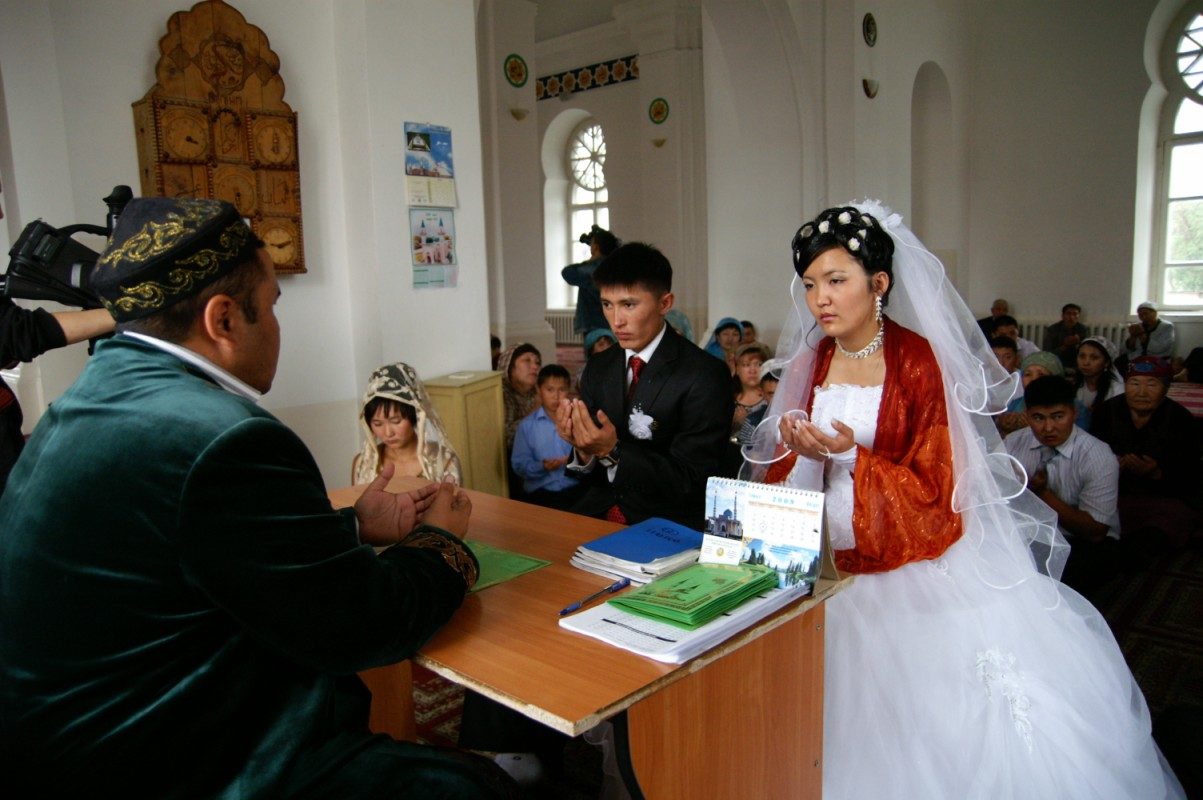
Begin with the canvas. Two by three meters, painted in 2002 by Kazakh artist Issatay Issabayev: a bride, face covered, caught in the suspended moment before the unveiling that is betashar. The veil here is not about concealment for its own sake. In Kazakh tradition, covering the face carries the symbolic weight of death — the covered bride is a woman whose former self is passing away. The uncovering is a rebirth. Issabayev spent from 1965 until the end of his life returning to this single image, which tells you everything about its density. This is not decoration. This is cosmology dressed in fabric.
An exhibition of Issabayev's work opened in Astana on Oct. 8, anchored on this one theme, the curator Saltanat Sabyr describing it as «radically different» from previous retrospectives precisely because of its singular focus. Issabayev is presented not as an illustrator of received folklore but, in Sabyr's words, as «an independent researcher of Kazakh traditions» who offers «his own analysis and perspective on the culture of the Kazakh nomads.» That distinction matters more than it might appear. It is the distance between a tradition that speaks for itself through its own practitioners and a tradition that has been packaged for outside consumption.
The cultural thesis behind this moment is not about one exhibition in Astana. It is about what happens when ceremonies that carry the grammar of survival — nomadic kinship structures, the symbolic logic of veiling and unveiling, the oral transmission of epic literature that situates a wedding inside a hero's entire lifespan — enter the aesthetic economy of Gulf luxury or Central Asian heritage tourism. The ceremony becomes content. The content gets a price tag. The question that nobody in the industry wants to sit with is: who set the price, and in whose currency is authenticity being measured?
Kazakhstan's cultural moment right now is unusually concentrated. The country just received new UNESCO heritage recognitions, and a Belgian royal delegation of over a hundred people, including ministers and business leaders, arrives in Astana and Almaty on Oct. 12. The diplomatic framing covers critical raw materials and transport connectivity, but heritage is always in the room at these meetings, even when it is not on the official agenda. Soft power travels with trade delegations. When European luxury conglomerates look for «authentic» reference points for capsule collections, for hotel interiors, for the kind of cultural gravitas that justifies a premium price point, they reach for exactly the kind of imagery Issabayev spent forty years refining.
At the same time, a novel called The Angel of Karaul — its protagonist a young woman whose body has been stunted by Soviet nuclear testing near Semipalatinsk — was presented at the Frankfurt Book Fair this month. Between 1949 and 1989, 456 nuclear tests were conducted at Semipalatinsk; the site closed in 1991. Roza Mukanova's book, originally written in Kazakh, has been reissued in English by the publisher Arman-PV. That reissue is its own kind of economic and aesthetic transaction. Trauma narrative has a market. The question of who controls the terms of that market — which languages get priority, which covers get designed by whom, which bookshops and which readers are the implied destination — is a supply chain question dressed in literary clothing.
The industry mechanic operating across all of this is what might be called heritage extraction. A ceremony, a poem, a trauma narrative acquires legibility in global luxury or literary markets only after it has been translated — linguistically, aesthetically, commercially. The translator holds structural power. When Kassym Amanzholov, whose 115th birth anniversary falls today, expanded Kazakh verse to carry conversational intonation through a 10-syllable line, he was doing the opposite: building a vehicle that served the tradition's own expressive needs, not the market's appetite for the exotic. The difference between those two projects is the entire argument.
Issabayev's daughter Aliya Tulenova explains that her father kept returning to betashar because wedding scenes are embedded in Kazakh heroic epics at structurally necessary moments — birth, heroic deeds, marriage. The ceremony is not a beautiful surface. It is load-bearing. When a designer lifts the visual language of a covered and unveiled bride without that structural knowledge, what gets sold is the silhouette without the architecture. The garment without the grammar.
The tension to watch next season: as Central Asian heritage markets grow more sophisticated about licensing their own visual culture, will the terms of authenticity be written in Astana and Almaty — or will they continue to be ratified in the showrooms and book fairs of cities that arrived at the ceremony much later, and much better funded?