This story is currently available in англійська only — a translation isn't ready yet.
Refining Is the Trade: Chevron's US Plants Ran at 98%, and the Margin Did the Rest
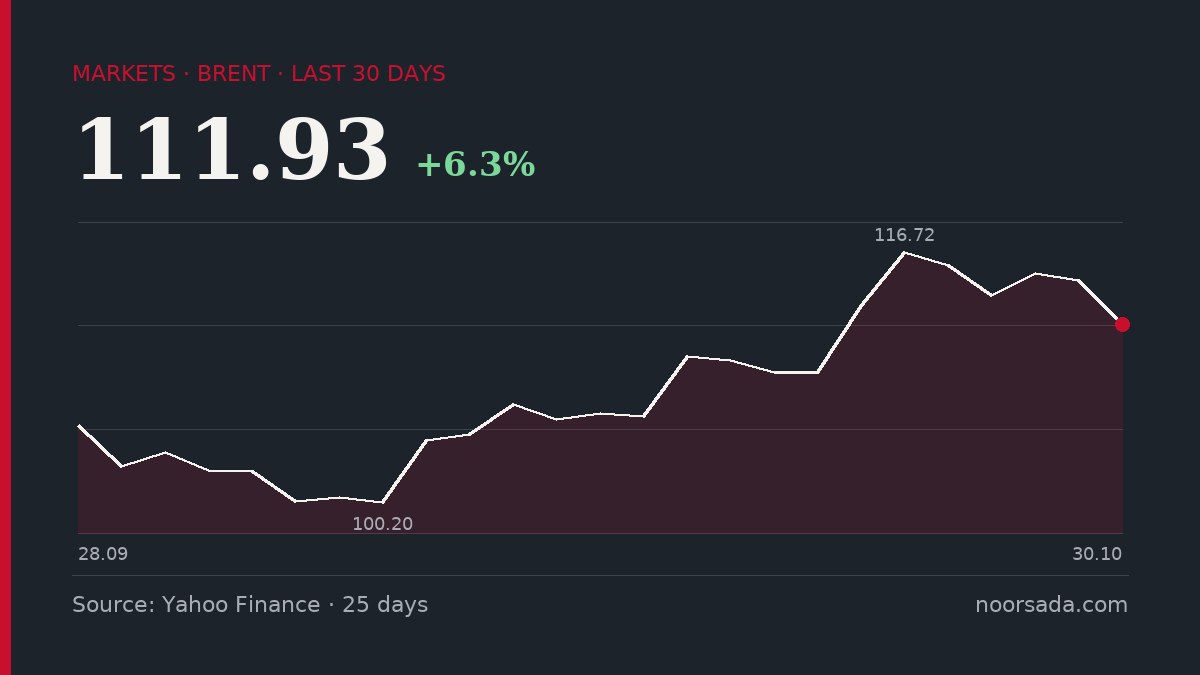
Roughly a tenth of global refining capacity is offline. Exxon's Gulf Coast ran flat-out. The crude headline is Brent near $118 — the real story is the crack spread.

Chevron's US refineries processed 1.09 million barrels a day in the third quarter at 98% utilisation, and the downstream unit earned $4.93 billion — more than four times the $1.14 billion booked a year earlier. US refining alone contributed $3.59 billion, against $638 million in the prior-year quarter. Fuel sales moved barely at all: 1.3 million b/d, roughly flat. Nearly three billion extra dollars came out of the same throughput. That is the number that frames this market, not the Brent tape.
The cause sits upstream of the refinery gate. Ukrainian strikes on Russian processing units and the disruption around the Iran theatre have taken an estimated 10% of global refining capacity out of circulation. Crude is abundant; the molecule the market cannot find is finished diesel. ExxonMobil's Gulf Coast units ran at 100% utilisation and posted their second-highest diesel volumes on record, feeding $15.4 billion of group profit — more than double the year-ago quarter — with the energy products segment alone contributing $9.05 billion in adjusted terms. For the first time in six years, Exxon earned more from downstream than from upstream. That inversion is the signal.
My reading is that the cartel has temporarily lost the wheel to the crack spread. OPEC+ sets the price of a barrel of crude. It does not set the price of a litre of diesel at a European pump — refiners do, and right now the refiners are the scarce asset. Brent trending around $118 is the headline, but the operational story is that a plant able to turn heavy sour into ultra-low-sulphur diesel is minting cash at any plausible crude price in this band.
The physical map explains the strain. European governments are releasing 42 million barrels of strategic reserves over three months, half of it diesel; France alone is drawing 10 million barrels and expects €0.12–0.18 off the pump within days. Saudi Aramco is reportedly offering discounted spot cargoes to European buyers for October and November arrival, routing through the Red Sea to sidestep Houthi fire. Moscow is extending its diesel export ban through January while carving out a quota for US-bound cargoes — up to 2.15 million tonnes in November, potentially 3.5 million tonnes by year-end. Note what each of these moves addresses: not crude supply, product supply. SPR releases of refined diesel are the clearest tell. Governments do not break glass on product stocks when the problem is upstream.
Inventory confirms it. The SPR drawdown is a product-side intervention. US crude production ran at 13.99 million b/d in the week to 23 October, up 723,000 b/d week-on-week — a 5.45% jump. There is no crude shortage in North America. Yet Valero has just agreed to buy LyondellBasell's idled Houston refinery for $320 million and plans to restart 165,000 b/d of distillation by end-2027. Capital is being deployed to buy back refining capacity the industry spent a decade retiring. European policymakers, who shut roughly a quarter of the continent's refineries and cut processing capacity about 10% over twenty years under the ETS framework, are now openly rethinking the phase-down. Infrastructure signs the treaties.
The near-term risks are physical and specific. Phillips 66 has declared force majeure on butane loadings from its 260,000 b/d Freeport terminal after a compressor failure — a reminder that at 98–100% utilisation there is no slack. One compressor, one transformer, one drone, and the margin becomes a shortage. Reported mine strikes on three tankers near Hormuz and explosions at Iran's Jask port are not yet a supply event; they are a premium on every cargo that insures through the Gulf. ADNOC's second 1.5 million b/d pipeline to Fujairah, bypassing Hormuz, is scheduled for first deliveries in early 2027. Until then, the chokepoint is priced in.
The kicker is capacity. No signed communiqué can rebuild a cracker in a quarter. Valero's Houston column comes back end-2027. ADNOC's bypass starts early 2027. Europe's SPR release lasts three months. Between now and then, whoever owns a running distillation tower on tidewater owns the trade.