AfD's power calculus in Saxony-Anhalt splits BSW
In the minister-president election on 15 December, AfD candidate Ulrich Siegmund failed to reach the required 42 votes in the first two rounds; BSW's 5 MPs have carried the 'firewall' debate into the party's own ranks.
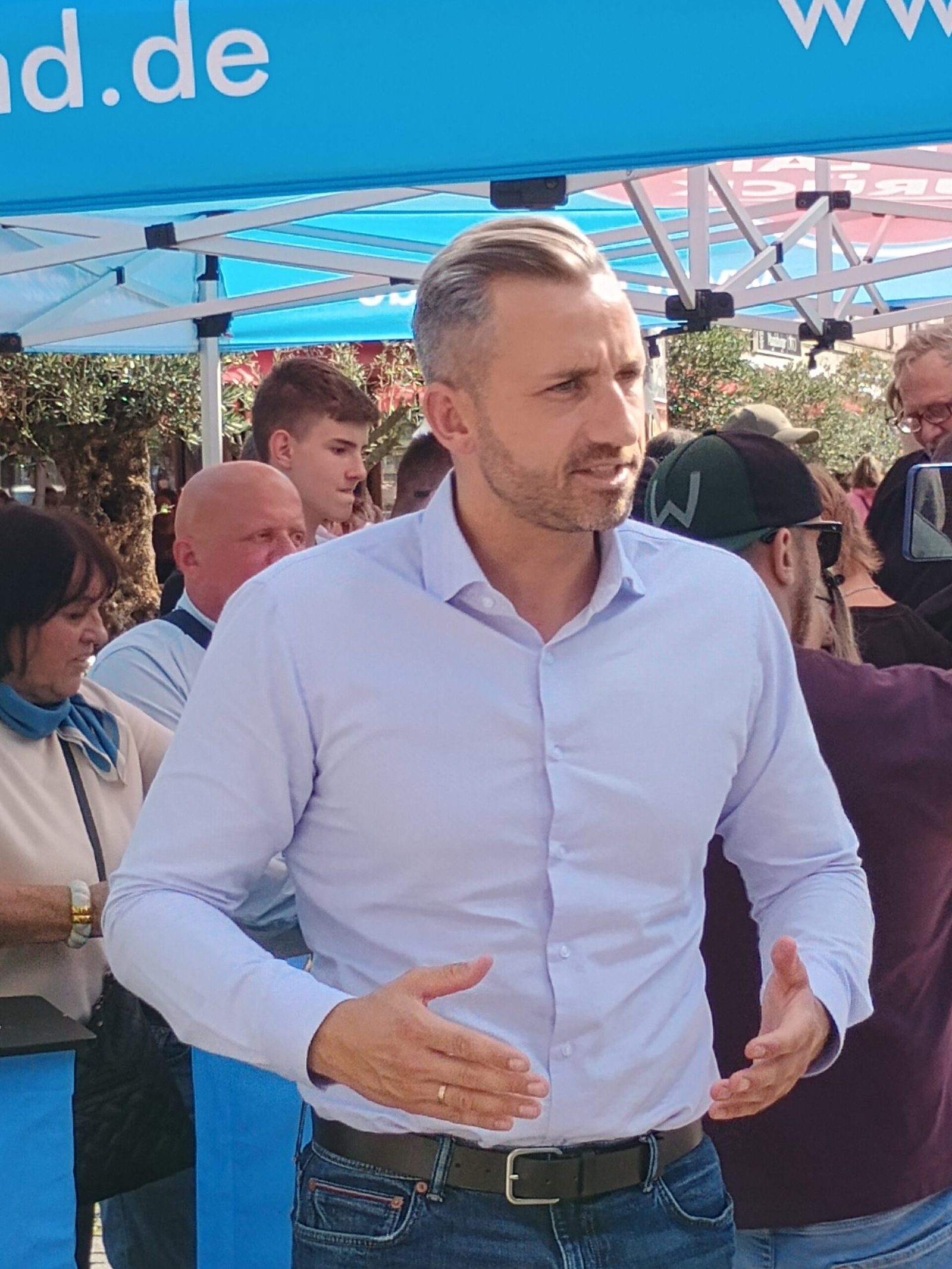
In the minister-president election planned for 15 December in the eastern German state of Saxony-Anhalt, the possibility that Alternative for Germany (AfD) becomes the first proto-fascist party to head a state government since the 1930s retains its weight. AfD, which holds 39 seats in the 83-member parliament, has not yet been able to bring its minister-president candidate Ulrich Siegmund to the 42 votes needed for election in the first two rounds. The 39 seats held in total by the CDU, SPD, Greens and Left Party are also not enough to stop AfD on their own. Because in the third round it is not the absolute majority of 52 votes but one more than half of the votes of those present that suffices, the failure to put up a joint candidate against Siegmund could give AfD an advantage. Siegmund has stated that he expects the election to be decided in the first round.
BSW, with its 5 MPs, has abandoned the stance of refusing political cooperation with AfD, namely the 'firewall', and announced that it will not adopt positions that would end up blocking the proto-fascist party from taking the head of government. BSW deputy federal chairmen Ralph Suikat and Jessica Tatti, in a joint article published on t-online on 17 November, criticised the state branch's rapprochement with AfD: 'The Magdeburg Way is a dead end.' The two officials wrote: 'In Saxony-Anhalt something entirely different is now at stake: BSW is preparing to take its place in AfD's camp.'
Suikat and Tatti do not entirely reject voting together with AfD on certain issues, but they oppose creating the impression of a political partnership between the two parties. They cite as examples AfD's withdrawal from the chairmanship of the education committee in favour of BSW's Claudia Wittig, and the appearance of representatives of both parties together at the opening of the Magdeburg studio of the far-right magazine Compact: 'In politics such gifts usually come at a price.'
A motion submitted to the BSW congress to be held in Dresden at the end of November aims to ban forming a coalition with AfD as well as giving outside support to a far-right government and permanent cooperation agreements. The motion was signed by Suikat and Tatti as well as senior party officials and founders such as Christian Leye, Amid Rabieh, Sevim Dağdelen, Klaus Ernst and Ralf Krämer. By contrast, the BSW Fundamental Values Commission chaired by Sahra Wagenknecht supports the 'Magdeburg Way'. Wagenknecht told Stern magazine that 'BSW is not playing on AfD's team'; while stating that no coalition would be formed with AfD and that no vote would be cast for Siegmund, she defended joint votes: 'In Saxony-Anhalt we will put into practice as much of BSW's positions as possible; whoever gives their approval, gives it.'
This approach is already in practice in the state parliament: AfD and BSW together pushed through a motion calling for a halt to new military aid to Ukraine, and on 12 November they took a joint stance against the regulation on public broadcasting.
The search for a joint candidate among the other parties continues. SPD parliamentary group leader Katja Pähle said the candidate should be someone known in the state who could win the support of different segments. Greens co-leader Felix Banaszak said: 'Our aim was to prevent a far-right government in Saxony-Anhalt, it is and it will remain so,' and added: 'We will not elect Ulrich Siegmund as minister-president.' The Left Party's candidate Eva von Angern, in her candidacy statement on 10 November, had said: 'We want not social devastation but affordable housing, good healthcare, reliable social services and strong municipalities.' The SPD criticised the statement for being made before joint talks; Pähle called it 'a personal political foray at the worst possible time.' Von Angern indicated that she could withdraw if an independent candidate acceptable to all were found.
Sources — how we know this
- PrimaryBianet