API Reports 11.12 Million-Barrel US Crude Draw as Hormuz Freight Eats a Third of Cargo Value
Inventories are bleeding, Brent sits above $106, and the physical cost of moving a barrel out of the Gulf has become the price signal that matters.

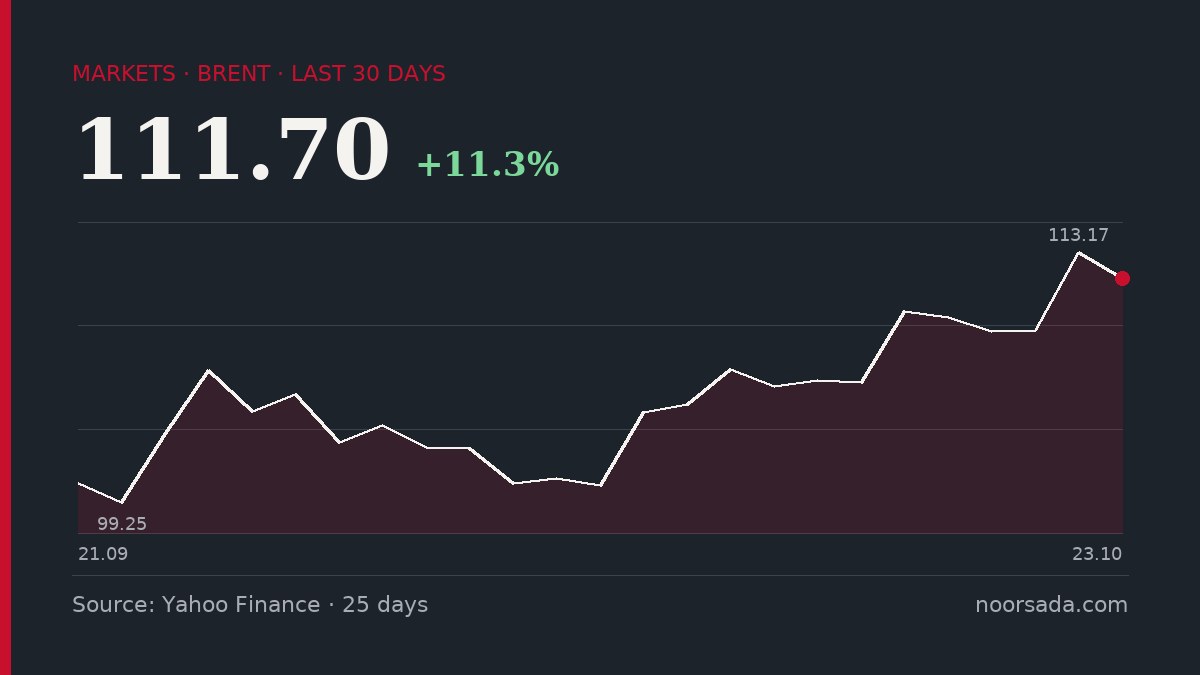
The American Petroleum Institute put last week's US commercial crude draw at 11.12 million barrels, against 2.09 million the week before. Twenty-six weeks of data now show a cumulative drawdown north of 51 million barrels. The Strategic Petroleum Reserve did not contribute to the latest week — it held at 283 million barrels, roughly 431 million below tank-top and only marginally above the 250–300 million operational floor at which the salt caverns start to misbehave.
The cause sits in the Strait of Hormuz. Iran has escalated attacks on shipping; one tanker-tracking service logged six vessels hit on October 11 alone, and UKMTO counted nine incidents in and around the strait in the first seven days of October — half the previous month's total compressed into a week. Reuters, citing maritime analysts, put the tally at a dozen attacks in the week to October 5. Transit counts diverge sharply by methodology: most trackers register flows close to pre-war rates thanks to ship-to-ship transfers off Oman; one outlier reported only two laden tankers crossing on October 12, both running dark.
Separate the physical from the financial. The physical move is this: Gulf barrels are reaching market, but via longer, more exposed routes, with STS transfers in Omani waters absorbing tanker capacity that would otherwise be lifting cargoes. The financial move is in freight. Shipping now accounts for close to a third of the delivered cost of a Gulf cargo, against under 5% before the war. That is not a hedge-fund rotation; it is war-risk insurance and scarcity of hulls repricing the molecule itself.
US supply offers only partial offset. Weekly production for the week ending October 2 printed at 13.979 million barrels per day, up 24,000 on the week and 350,000 on the year. That is a respectable trajectory, but the arithmetic does not close: a draw of 11.12 million barrels in seven days implies the shortfall between domestic production, net imports and refinery intake is running at roughly 1.6 million barrels per day. Imports are the variable, and imports are what Hormuz freight rates are rationing.
Demand continues to clear at these prices, which is the uncomfortable part. Brent above $106 has not yet triggered the destruction curve on gasoline consumption that bulls would need to fear. The product side tells the story: US diesel is above $6, and the White House has reached for the Defense Production Act — a 1950 statute — to expand a single Texas refinery owned by Delek, in Tyler. The Vice President announced the move at a rally. One refinery expansion, authorised under a Korean War-era law, is not a supply response. It is an admission that conventional levers have been exhausted.
Gas is drawing its own map. Washington announced a Taiwan commitment to lift roughly 30% of planned Alaska LNG output over twenty years, alongside a $4.4 billion equity contribution, with headline value put at $70–80 billion. South Korea was tagged for a $50 billion investment in the same project. Alaska LNG remains unbuilt. The signalling matters — Asian buyers are willing to prepay to route around Hormuz — but a cargo loaded in Nikiski in 2032 does not cool a European or Japanese spot market in the fourth quarter of 2026.
Meanwhile, Moscow has pocketed something it did not expect: a US diesel import arrangement, flagged by Deputy Prime Minister Novak as a 'positive signal' and now in contract finalisation between Russian state entities and American counterparties. Six months ago this would have been politically unthinkable. Diesel above $6 made it thinkable.
The kicker is capacity. The SPR cannot be drawn much further without operational risk. Alaska LNG will not deliver a molecule this decade. Delek-Tyler is one refinery. Gulf tanker throughput is capped by hulls willing to accept the war-risk premium, not by wellhead output. The next quarter's balance will be set by how many ships load at Ras Tanura and Kharg, and at what insurance quote — not by a social media post.