Israeli army drops explosive boxes onto roofs in Gaza with UAVs and detonates them remotely
According to the AA report based on eyewitness accounts, the method has been concentrated in Zeitoun, Tuffah, Deir al-Balah and Bureij for about a week.
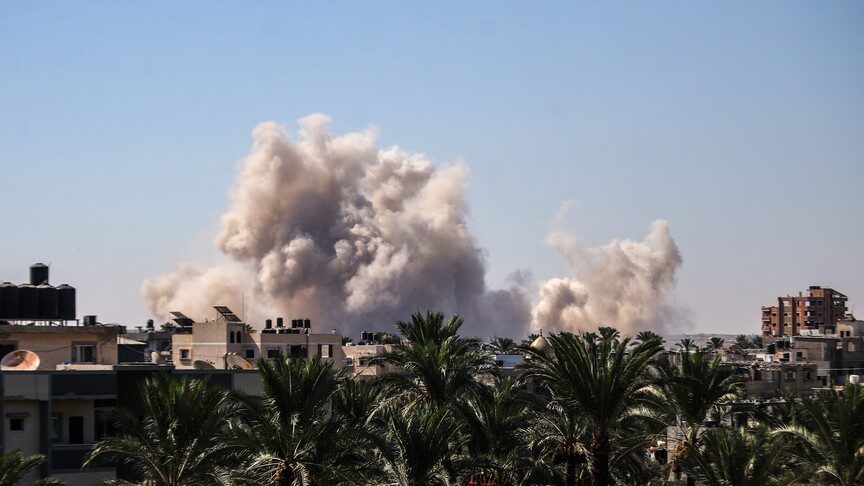
The Israeli army is dropping explosive boxes with high destructive power onto buildings in the Gaza Strip using four-rotor "quadcopter"-type unmanned aerial vehicles (UAVs) and detonating them by remote control. According to the report by Anadolu Agency (AA), based on residents and eyewitnesses in the area, for about a week the UAVs have been lowering boxes containing kilograms of explosives onto the roofs of, or around, houses near areas known as the "Yellow Line" under Israeli army control.
The remotely detonated boxes cause violent explosions in the targeted buildings and their surroundings. In footage recorded by Palestinian activists, UAVs are seen dropping the boxes they carry onto roofs and then detonating them remotely, both razing the targeted buildings and causing heavy damage to surrounding structures.
The attacks are concentrated in the Zeitoun and Tuffah neighborhoods east of Gaza City, as well as east of the city of Deir al-Balah in the central part of the strip and in the Bureij Refugee Camp. Local sources reported that yesterday morning, near the Wadi Gaza Bridge on Salah al-Din Street, north of the Bureij and Nuseirat refugee camps, explosive boxes dropped by UAVs were detonated. It was recorded that the detonation was repeated at least seven times and that the violent explosions caused large-scale destruction.
According to local sources who spoke to the AA correspondent, the Israeli army on 10 November blew up two previously evacuated houses east of the Maghazi Refugee Camp in the central Gaza Strip using the same method. Four separate detonations were carried out around Dar al-Salam Hospital northeast of the city of Khan Younis, while similar attacks were recorded east of the Zeitoun neighborhood on 14 November.
The method, which causes fear and panic in the area, is forcing civilians to migrate once again. Local sources reported that dozens of Palestinians, worried that their homes would be blown up, were forced to migrate from the Zeitoun neighborhood.
The destruction continues despite the ceasefire agreement that followed the attacks launched on 10 October 2023. In the report of the United Nations Office for the Coordination of Humanitarian Affairs (OCHA) on the first month of the ceasefire, it was stated that restrictions on civilians' access to these areas continue and that reports of homes being destroyed with explosives every day continue to come in.
According to the latest figures announced by the Gaza Ministry of Health, 1,647 Palestinians lost their lives and 5,969 people were injured as a result of Israel's violations of the ceasefire. In the attacks launched on 8 October 2023, which the UN and human rights organizations describe as "genocide," more than 74,000 Palestinians, most of them children and women, lost their lives and more than 176,000 people were injured. In Gaza, where about 90 percent of the infrastructure has been destroyed, the cost of reconstruction is estimated to reach 71.4 billion dollars according to UN data.
The Israeli army had previously also placed old military vehicles loaded with explosives between buildings in various neighborhoods of Gaza and detonated them remotely, destroying residential blocks with this method.
Sources — how we know this
2 independent sources corroborated this
- PrimaryAnadolu Ajansı (TR)
- CorroboratingTRT Haber