Prof. Dr. Arslan: Even in structures compliant with regulations, if columns are cut, collapse is inevitable
Prof. Dr. Arslan, a member of the Damage Assessment Board of the Türkiye National Risk Shield Model, drew attention to collapses caused by column cutting and the zoning amnesty on the 27th anniversary of the Düzce Earthquake.
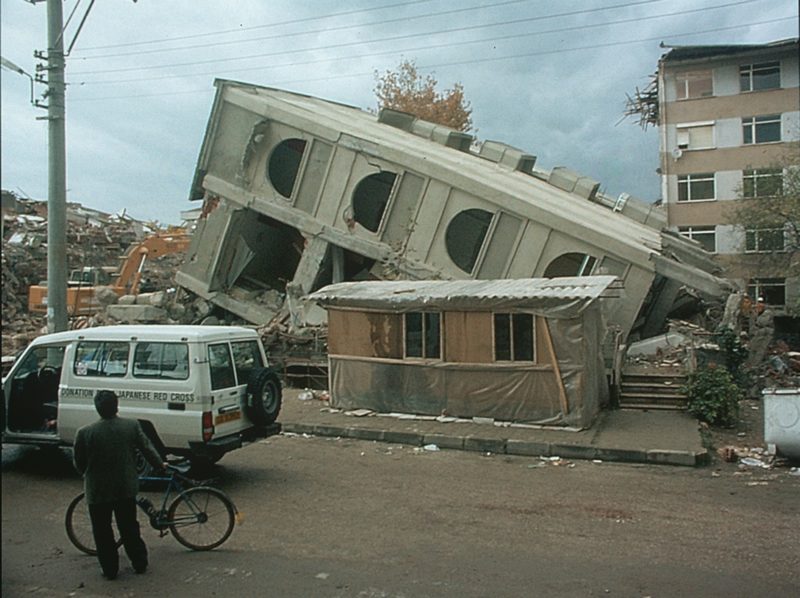
Speaking to Anadolu Agency, Prof. Dr. Arslan, a member of the Damage Assessment Board of the Türkiye National Risk Shield Model, assessed building damage on the 27th anniversary of the 12 November 1999 Düzce Earthquake and warned that even in structures designed in compliance with regulations, collapse is inevitable once they are subsequently altered.
Arslan said that the earthquakes centered in Kahramanmaraş on 6 February 2023 differed from one another in terms of the size of the area they affected and the acceleration values recorded. He stressed that despite these differences, buildings that had received no engineering service and that collapsed due to interventions made afterwards displayed similar characteristics in both earthquakes.
Noting that a large part of the damage during the earthquake stemmed from failure to comply with the regulatory conditions related to construction, Arslan said the damage originated from issues such as "primarily column dimensions, and the confinement in columns and beams," and that beams must be made stronger than columns. Expressing that if any element is to be damaged during the shaking, the beams should be damaged first, he said, "if our leg breaks we cannot stand; if our arm breaks, of course it is important, but we can stay standing," and stressed that it is desirable for people to be able to walk out of the building.
Reporting that they had prepared a comprehensive report on the damage to structures after the Kahramanmaraş-centered earthquakes, Arslan said that short columns and soft-story formations, torsional irregularities and adjacent-order buildings were prominent problems. Arslan said these problems are already taken into account and calculated in the regulations, but that they caused collapse because they were overlooked when they should have been eliminated through prior interventions, and because there was no inspection.
Explaining that in some examples the structure, even if built in compliance with regulations, suffered high damage or collapse, Arslan said he had encountered interventions such as column cutting. Stating that as an engineer he saw "a behavior very different from the project he first designed, during the earthquake," Arslan said the load distributions in the structure occurred differently than expected, and that as a result collapse was inevitable and caused disaster. Arslan, noting that the interventions stemmed from ignorance, said, "a sane person would not do this."
Noting that column-cutting cases were seen only in the provinces affected by the earthquake, Arslan said he had worked in the Gaziantep area but that the situation was not specific to Gaziantep, and that the same thing was seen in Kahramanmaraş, Adıyaman and Malatya. Stating that he observed many collapses especially in structures that had benefited from the zoning amnesty, Arslan noted that buildings were built as 1-2 stories with rebar starters left on top, that additional floors were later attempted, and that when an intervention affecting the calculation is encountered, collapse is inevitable.
Sources — how we know this
- PrimaryAnadolu Ajansı (TR)